
What's New
SAP Proposes Dividend of €2.20 per Share and Announces Candidates for Shareholder Representative Elections
WALLDORF — The Supervisory Board and Executive Board of SAP SE (NYSE: SAP) recommend that shareholders approve a dividend of €2.20 per share for fiscal year 2023. If approved by shareholders and assuming the same level of treasury shares as at December 31, 2023, the total amount distributed in dividends would be approximately €2.568 billion (2022: €2.393 billion), representing a pay-out ratio of 43.1% (2022: 139.6%).
SAP believes that its shareholders should benefit appropriately from the profit the Company made in 2023. The Company’s dividend policy is to pay a dividend totaling 40% or more of profit after tax.
The following dates are relevant for the dividend payment:
- Record date for dividend payment: May 15, 2024
- Ex-dividend date: May 16, 2024
- Payment date: May 21, 2024
As announced on February 11, 2024, the Supervisory Board has nominated Pekka Ala-Pietilä to stand for election at the 2024 Annual General Meeting of Shareholders (AGM) as shareholder representative on the SAP Supervisory Board.
- Dr. h. c. mult. Pekka Ala-Pietilä (67), Helsinki, Finland, Chairman of the Board of Directors of Sanoma Corporation, Helsinki, Finland. In case of election, his term would expire in 2026. The Supervisory Board intends to elect him as chair.
Further, the Supervisory Board is announcing the nomination of the following candidate to stand for election:
- Prof. Dr. Ralf Herbrich (49), Falkensee, Germany, Managing director, professor for artificial intelligence and sustainability, Hasso Plattner Institute for Digital Engineering gGmbH, Potsdam, Germany. In case of election, his term would expire in 2028.
Additionally, three candidates have been nominated to stand for re-election:
- Aicha Evans (54), Los Gatos, CA, USA, Chief Executive Officer and member of the Board of Directors, Zoox, Inc., Foster City, California, USA. In case of re-election, her term would expire in 2028.
- Gerhard Oswald (70), Walldorf, Germany, Managing director, Oswald Consulting GmbH, Walldorf, Germany; Associate lecturer, Technical University of Munich, Munich, Germany. In case of re-election, his term would expire in 2026.
- Dr. Friederike Rotsch (51), Königstein im Taunus, Germany, Group General Counsel, Deutsche Bank AG, Frankfurt, Germany. In case of re-election, her term would expire in 2028 and she would continue in the role of Lead Independent Director (LID).
These nominations are in alignment with the Profile of Skills and Expertise, the Supervisory Board’s Diversity Policy, and the objectives set by the Supervisory Board for its own composition.
Note to holders of SAP ADRs (American Depositary Receipts):
One SAP ADR represents one SAP SE share. The final dividend amount per ADR is dependent upon the euro/US dollar exchange rate. Since SAP SE pays cash dividends on the ordinary shares in euro, the exchange rate fluctuations will affect the US dollar amounts received by holders of ADRs. The final dividend payment by SAP SE to the depositary bank is scheduled for May 21, 2024. The depositary bank will then convert the dividend payment from euro into US dollars as promptly as practicable.
Visit the SAP News Center. Follow SAP at @SAPNews.
Subscribe to receive weekly news highlights from the SAP News Center Sign upAbout SAP
SAP’s strategy is to help every business run as an intelligent, sustainable enterprise. As a market leader in enterprise application software, we help companies of all sizes and in all industries run at their best: SAP customers generate 87% of total global commerce. Our machine learning, Internet of Things (IoT), and advanced analytics technologies help turn customers’ businesses into intelligent enterprises. SAP helps give people and organizations deep business insight and fosters collaboration that helps them stay ahead of their competition. We simplify technology for companies so they can consume our software the way they want – without disruption. Our end-to-end suite of applications and services enables business and public customers across 26 industries globally to operate profitably, adapt continuously, and make a difference. With a global network of customers, partners, employees, and thought leaders, SAP helps the world run better and improve people’s lives. For more information, visit www.sap.com.
Note to editors:
To preview and download broadcast-standard stock footage and press photos digitally, please visit www.sap.com/photos. On this platform, you can find high resolution material for your media channels.
For customers interested in learning more about SAP products:
Global Customer Center: +49 180 534-34-24
United States Only: 1 (800) 872-1SAP (1-800-872-1727)
For more information, financial community only:
Anthony Coletta, +49 (6227) 7-60437, investor@sap.com, CET
Follow SAP Investor Relations on LinkedIn.
For more information, press only:
Joellen Perry, +1 (650) 445-6780, joellen.perry@sap.com, PT
Daniel Reinhardt, +49 (6227) 7-40201, daniel.reinhardt@sap.com, CET
SAP Press Room; press@sap.com
This document contains forward-looking statements, which are predictions, projections, or other statements about future events. These statements are based on current expectations, forecasts, and assumptions that are subject to risks and uncertainties that could cause actual results and outcomes to materially differ. Additional information regarding these risks and uncertainties may be found in our filings with the Securities and Exchange Commission, including but not limited to the risk factors section of SAP’s 2022 Annual Report on Form 20-F.
© 2024 SAP SE. All rights reserved.
SAP and other SAP products and services mentioned herein as well as their respective logos are trademarks or registered trademarks of SAP SE in Germany and other countries. Please see https://www.sap.com/copyright for additional trademark information and notices.
Digital Eco-Farming: How SAP Japan Helps Revitalize Rural Communities
With rural population in decline, many communities in the Japanese countryside struggle to continue farming and harvesting their land. SAP partner PSI and SAP Co-Innovation Lab in Japan launched a co-innovation project to help the town of Minano revitalize its community.
Like other industrial nations, Japan has been facing massive demographic challenges in its agriculture sector. An aging population and a lack of younger individuals entering the sector to replace them have led to farms being abandoned and fields lying fallow.
Japan’s government has realized the demographical issue, of course, as it touches not only the agricultural sector. To revitalize rural areas and stem the rural exodus, the government launched a national action plan.
In alignment with this action plan, SAP Japan has joined the effort of encouraging rural communities to thrive by launching a co-innovation project with PSI, an SAP partner, and the local government of the town of Minano.
Digitizing the Agricultural SectorThe small town of Minano is located in the hills of Saitama Prefecture, about two hours from Tokyo. While the south of this prefecture is largely a suburb of the Tokyo area, the west, approaching Mt. Fuji, is still very rural and thinly populated. A former center of silk industry, the region on average is sunny and warm but can get lots of snow in winter.
“Farms in this area are traditionally small and dispersed, located between forests and mountains,” says Yoshihisa Horiguchi, chairman of MINNANO Future Create. “Big supermarkets and retailers overlook them. Nowadays, the farmers cultivate rice and vegetables in small amounts to consume themselves, sell to their neighbors, or send to their children or grandchildren that live in cities.”
Since 1950, Minano has lost roughly one-third of its population, largely due to the decline of the agricultural sector. Today, it counts about 10,000 inhabitants.
“Young people often migrate to urban areas for better education and employment opportunities,” Horiguchi explains. “Where 50 years ago, a farm may have relied on 20 young workers, now only two elderly workers are left.”
Digitization is one obvious approach that may help prevent those areas from depopulating completely.
“But while large-scale farms benefit from the economic feasibility of applying robotics and the like, it is financially and logistically challenging to apply such technologies to small-scale dispersed farms,” Horiguchi says.
Horiguchi, the owner of an automotive parts manufacturing company, co-founded the local initiative MINNANO Future Create in 2019 to solve the challenges resulting from population loss. Its members range from elderly individuals to young residents, forming a diverse group of individuals, including pharmacists, architectural designers, and other professions, all living in the town.
For one of its projects, the Minano Digital Eco Farm, it partnered with SAP Co-Innovation Lab.
IoT Solution for Monitoring AgricultureThe Minano Digital Eco Farm project aims to build a communication platform that connects farmers and urban residents as well as small-scale dispersed farms to major supply chains, forming a portfolio that coexists with existing large-scale farms. In alignment with the United Nations’ Sustainable Development Goals (SDGs), the project will help overcome supply chain disruptions due to food shortages and crop failures due to abnormal weather, conflicts, disasters, and more.
For this vision to become a reality, Internet of Things (IoT) sensors were distributed in various locations and managed remotely from headquarters.
Tap the power of SAP BTP to integrate and connect landscapes Learn more“The idea was to have an IoT solution running on SAP Business Technology Platform (SAP BTP) that would help monitor all the agricultural processes,” says Atsushi Minakuchi, senior solution specialist at SAP Co-Innovation Lab in Japan.
SAP Co-Innovation Lab partnered with PSI, which brought in the Digital Material Controller (DMC), an all-in-one compact edge controlling server that enables easy setup of a ubiquitous IoT environment. And, due to the cooperation with SAP Co-Innovation Lab, the DMC has also obtained SAP certification.
“Many IoT sensors lack cybersecurity functions,” Mitsuhiro Yamazaki, senior advisor and former president of PSI, says. “However, by connecting sensors to a DMC with cybersecurity capabilities, it becomes possible to securely store locally collected data on the DMC, safely transmit to SAP BTP, and accumulate, analyze, and utilize data from the DMC. This enables seamless and easy integration between the SAP core system and the IoT system.”
“Collaboration with SAP Co-Innovation Lab has significantly expanded the application possibilities of DMC,” Masaki Fukui, former PSI Cyber Security Lab director and now with the Ministry of Internal Affairs and Communication, says. “Global users of SAP now could have the opportunity to easily implement and utilize a ubiquitous supply chain platform through the combination of DMC and SAP BTP.”
Through integration with SAP BTP, the deployment locations can then be displayed and monitored on a dashboard.
The idea is for citizens living in the city to enter a service contract with a rural farm or supplier and to connect via a technology platform to remotely monitor and support agricultural processes. In return, they receive part of the crops – freshly delivered to their homes in the city.
So far, two proofs of concept for farms have been completed between March 2019 and November 2022, as well as one proof of concept for a miso factory. Agriculture and rural industry are only two fields of application. Future projects could include schools, hospitals, stores, and elder care facilities.
Strengthening Rural Appeal for Inland Tourism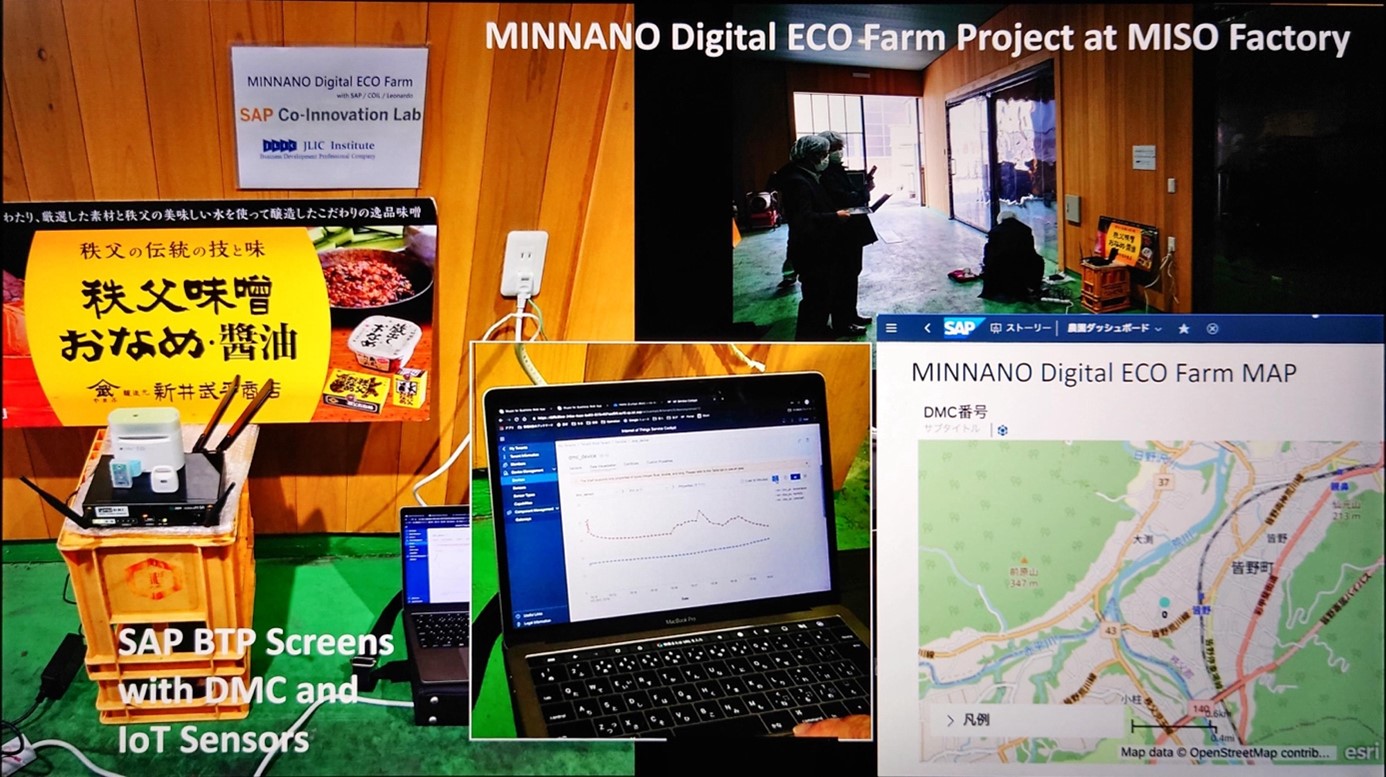
As a corporate social responsibility project, the Minano Digital Eco Farm came to life through the voluntary engagement of SAP employees in Japan who supported the project on top of their regular work.
The project is supported by a government program unique for Japan, the so-called hometown tax payment, which makes it possible for citizens to choose and support the region they were born and raised in or a community they wish to engage with.
“The possibility of hometown tax payment is very popular among Japanese people,” Hidenori Kurosawa, vice governor of Minano, explains. “To us in rural regions, it seems that this played a significant role in creating an interest in the countryside. People want to get to know and support local towns.”
Indeed, the appeal of small, thinly populated communities surrounded by beautiful forest landscape hasn’t gone unnoticed by Japanese inland tourists.
Kurosawa says: “We wish to make Minano appealing to visitors by offering return gifts that provide an experience – that allow visitors to come to the town, interact with the locals, and experience things that are unique to this place.”
The Minano Digital Eco Farm project aligns well with this strategy. Not only does it promote Minano’s charm but, by expanding initiatives, it addresses local challenges such as reclamation of abandoned farmland, increased self-sufficiency in food, reduction of CO2 emissions, and improved profitability in agriculture.
“We have great expectations that this initiative will contribute to addressing the town’s challenges and advancing the UN SDGs,” Kurosawa states. “We express our sincere gratitude to the volunteers from SAP Japan who provided invaluable assistance in bringing the Minano Digital Eco Farm project to life.”
“MINNANO” means “for everyone” in Japanese and is pronounced the same way as the name of the town. Fukui from the Ministry of Internal Affairs and Communication explains the idea behind that name: “One action can have multiple meaningful impacts. The issue of unseen small-scale dispersed farms facing economic challenges can be witnessed around the globe. By collaborating with SAP, we hope to inspire rural communities beyond our own prefecture, maybe even beyond Japan.”
Connect with us on LinkedIn to stay up-to-date Follow SAP NewsTotal Workforce Management Evolution: How OG&E and Brightspeed Manage Employees and Contingent Workers
In today’s dynamic world, the workforce is not only confined to permanent employees. A significant change in recent years is the rise of external workers, heightening the need to proactively manage everyone – from full- and part-time employees to services providers and contingent workers – all while reducing manual processes. This is now an integral part of many companies, including Oklahoma Gas & Electric (OG&E) and Brightspeed.
A total workforce management strategy allows businesses to keep the whole workforce in focus for increased agility, productivity, and bottom-line impact.
OG&E’s experience with contingent and contract labor is unique. Despite the 121 years under its belt, OG&E has embraced the changing landscape of employment with open arms. For over 25 years, OG&E has been utilizing SAP solutions, including SAP Fieldglass solutions for over a decade. Together with the HR solutions of SAP SuccessFactors, SAP Fieldglass solutions – a comprehensive vendor management portfolio for external labor – help pave the way for the successful workforce management of permanent and contingent and contract labor.
The challenge lies in determining which positions to fill with contingent workers or profile workers, a process OG&E has mastered over the years. The decision hinges on the specific skills required and the immediacy and duration of the need. This flexible approach has enabled OG&E to successfully bring in workers with diverse profiles for various projects, such as its recent SAP SuccessFactors Human Experience Management (HXM) Suite implementation project.
Ownership of this process is shared between the departments of HR, the business units, and procurement, reflecting a trend observed across various organizations. A study conducted in 2022 revealed that HR was responsible for external worker functions about 51% of the time.* This is a testament to the rising importance of contingent and profile workers and the need for HR to engage them effectively.
However, this process isn’t without its complexities, necessitating collaboration between HR and procurement. Issues such as rate cards and other procurement-specific processes require strong cooperation between the two functions.
Previously, a lack of comprehensive understanding about OG&E’s workforce made everyday HR and finance decisions increasingly challenging. The management of contingent workers through SAP Fieldglass solutions was handled by a third party. However, the transition to internal management provided more visibility.
HR teams must plan, source, and manage their workforce across all types of labor Watch a videoThis has empowered OG&E to make more informed decisions. For example, OG&E had 10 excellent candidates from different suppliers for a position, two of which came at a significantly higher cost. Recognizing the value of the other eight candidates, it challenged the high markup, resulting in one supplier lowering its rate. This type of negotiation was previously not possible for OG&E due to the lack of visibility, but now it’s an integral part of the process.
In contrast, Brightspeed, a company that has recently started out, is managing a dynamic workforce of 4,200 employees and almost as many contractors. Its mission? To lay high-speed fiber in the South and Midwest of the United States. Alongside this, it also had a recent divestiture from Lumen, with hundreds of inherited applications and a fresh contingent workforce.
But its workforce needs are ever-evolving. With a contingent workforce that ebbs and flows according to the company’s needs, Brightspeed is flexible and can adapt, from field workers laying fiber to IT specialists building new applications.
Brightspeed utilized SAP’s suite of applications to help streamline its operations post-divestiture. Lumen had already implemented SAP SuccessFactors solutions and SAP Fieldglass solutions, so Brightspeed decided to create a seamless transition and continue to use these solutions. The suite it uses now includes SAP SuccessFactors solutions, SAP Fieldglass solutions, and SAP S/4HANA.
The SAP Fieldglass portfolio is used to help manage contingent workers. Within this context, Brightspeed’s managed service provider plays a crucial role. It liaises with the hiring manager, handles candidate selection, and ultimately delivers the temporary worker in SAP Fieldglass solutions. These workers are then trained in compliance and technical procedures, with all the information interfaced back into SAP SuccessFactors Learning. From an SAP S/4HANA perspective, cost center project activities and other elements are pushed out to its time system and raw time is imported to SAP S/4HANA, capturing millions of dollars in project cost every pay period.
However, the journey wasn’t without its challenges. As a young company, Brightspeed had a massive task ahead of it in getting these systems up and running in just 10 months. The team successfully navigated this initial hurdle, but soon realized it hadn’t fully prepared for the post-go-live period due to the compressed implementation period. This led to a challenging few months, as it scrambled to train personnel and resolve system errors. Despite this, the team has since stabilized operations.
As these examples show, the role of contingent and profile workers is evolving and becoming increasingly integral to the success of organizations. They are no longer just field workers but are being relied upon for specific skill sets. This allows companies like Brightspeed and OG&E to stay agile, adapt to business needs, and manage their contingent and profile workers as well as their permanent employees.
A total workforce management strategy, when done right, can leverage the full potential of a diverse workforce and make companies more agile. SAP SuccessFactors solutions and SAP Fieldglass solutions can work together to help create and manage a dynamic, flexible workforce that can easily adapt. The experiences of OG&E and Brightspeed highlight the importance of strategic planning and the effective use of technological tools in managing the workforce.
Andrea Domhardt is part of Product Marketing for SAP SuccessFactors.
*“Workforce Solutions Buyer Survey 2022, Americas,“ Staffing Industry Analysts, 2022.
Get the latest SAP news delivered right to your inbox Subscribe to our newsletterSAP Further Strengthens Focus on AI with Dedicated Growth Area
WALLDORF — SAP SE (NYSE: SAP) has created a new end-to-end growth area focused on AI under the leadership of Dr. Philipp Herzig in the newly created role of chief artificial intelligence officer (CAIO).
The new unit oversees the entire value chain for SAP Business AI, from product development and research through to customer implementation. In this new role, effective January 2024, Herzig reports directly to CEO Christian Klein.
Be ready for AI built for business with SAP Learn howHerzig’s team will collaborate with innovators across SAP to infuse artificial intelligence into every part of the company’s portfolio. With this new setup, SAP aims to further accelerate the pace at which customers can benefit from groundbreaking business AI solutions and services. The newly established division also underscores the central importance of business AI as a strategic driver for SAP’s ongoing growth.
Herzig’s team consists of strong leaders, including Walter Sun, who continues to lead all product engineering efforts on business AI, as the global head of AI. Sun moved from Microsoft to SAP in September 2023.
“SAP’s increased focus on business AI marks the start of a completely new generation of enterprise innovation, and I’m honored to have the chance to help customers make the most of this unprecedented opportunity,” said Philipp Herzig, CAIO at SAP. “I look forward to working with our team, as well as our ecosystem of customers and partners, to drive the development and delivery of relevant, reliable, responsible business AI that fundamentally changes the way business runs.”
Visit the SAP News Center. Follow SAP at @SAPNews.
Media Contacts:
Hilmar Schepp, +49 6227 7-46799, hilmar.schepp@sap.com, CET
Alex Vaught, +1 (206) 678-5712, alex.vaught@sap.com, PST
SAP Press Room; press@sap.com
This document contains forward-looking statements, which are predictions, projections, or other statements about future events. These statements are based on current expectations, forecasts, and assumptions that are subject to risks and uncertainties that could cause actual results and outcomes to materially differ. Additional information regarding these risks and uncertainties may be found in our filings with the Securities and Exchange Commission, including but not limited to the risk factors section of SAP’s 2022 Annual Report on Form 20-F.
© 2024 SAP SE. All rights reserved.
SAP and other SAP products and services mentioned herein as well as their respective logos are trademarks or registered trademarks of SAP SE in Germany and other countries. Please see https://www.sap.com/copyright for additional trademark information and notices.
SAP Goes the Distance with EV Fleet Digitalization
Electric vehicles (EVs) are transforming the mobility experience in corporate fleet management. A great example is the partnership between Mercedes-Benz and SAP where the companies are both customers and vendors to each other. Mercedes-Benz is using SAP solutions to digitalize its omnichannel buying experience, and SAP is the first customer using its own technology to manage the company’s vehicle fleet in Germany.
As longtime partners, SAP and Mercedes-Benz have a history of shared knowledge for mutual competitive advantage. The fleet management program is grounded in the companies’ similar business philosophies and product road maps.
Mercedes-Benz has committed to move the company’s B2B business to 100% digital and plans to sell 25% of all new cars online by 2025. The company selected SAP Commerce Cloud to help support this mission. It will create a future-proof composable commerce portfolio designed to reliably power the company’s digital strategy, including a standardized offering across different markets. It will also simplify processes and reduce time-to-market.
Benefits of Digitalized Fleet ManagementFrom the SAP employee’s perspective, ordering a company EV couldn’t be simpler. Instead of time-consuming manual research and back and forth communication with the car dealer, employees can use the guided buying capability in SAP Ariba solutions to order the EV they want directly from the Mercedes-Benz online catalog. They can choose the features they want, such as car make and model, color, and equipment packages, within SAP’s pre-set guidelines.
“The car configurator automates the EV selection process end-to-end, eliminating manual steps and saving time while providing the employee with a highly personalized experience,” said Steffen Krautwasser, head of SAP’s global car fleet. “Automating the approval process assures data consistency and eliminates the need for manual quality checks.”
There’s a tremendous convenience factor in captured EV data as well. In one pilot program for select EVs in SAP’s fleet, the digital twin will automatically track mileage. Drivers will no longer need to manually enter mileage every time they recharge, and SAP can use this data to better manage the fleet.
Connected Data Drives Sustainable BusinessOnce ordered, EVs are tracked as assets in SAP’s financial system. After delivery, SAP Digital Vehicle Suite creates a digital twin that can capture relevant, secure data across the EV’s lifetime. SAP’s fleet management team can track CO2 emissions based on green energy usage, mileage, and the number of vehicles on the road. Krautwasser envisioned reporting this data to support the company’s global sustainability commitments.
SAP Digital Vehicle Suite delivers a holistic approach to vehicle, sales, and data management Learn more“Performance data from the EV digital twin can help corporate fleet managers guide employees in choosing the best vehicle for their driving needs,” said Krautwasser. “Over time, drivers can better understand travel ranges between charges.”
Data is expected to help address so-called range anxiety, alerting EV drivers when their vehicle needs a charge and, most important, where to recharge. Mercedes-Benz is investing in charging infrastructure to create an ecosystem that would be integrated with public and private charge point providers in the U.S., China, and Europe.
The partnership also reflects a shared commitment to sustainability. Mercedes-Benz has committed to become carbon neutral by 2038, and transition to 100% electric vehicles by 2030 wherever possible. SAP is transitioning the company’s vehicle fleet for employees in Germany to all EVs by 2025 as part of its corporate commitment to be carbon neutral by 2030.
Omnichannel Is Fastest Path to Customer LoveThe digital experience is extremely important for customers who expect convenience and quality. Organizations in many industries have shifted to an omnichannel strategy that offers people their preferred experience, whether online or in-person, building brand loyalty and repeat business.
“We want to provide a seamless journey for employees as they research, select, purchase, and enjoy their vehicle,” said Krautwasser. “The most exciting part of our EV fleet management strategy is how we can use our knowledge to enhance the employee experience. Through data and digital services, we can get closer to our employees and act quickly based on their feedback, making improvements and introducing new offerings that keep us on top of trends and support SAP’s sustainability commitment.”
EVs represent a profound business model shift for the entire automotive supply chain as automakers sell direct to customers, provide digital services from vehicle data, and explore new revenue opportunities. It’s clear that Mercedes-Benz and SAP are going the distance for a sustainable and satisfying driving experience.
Susan Galer is a communications director at SAP. Follow her @smgaler.
Top photo courtesy of SAP employee Jude Calvin Parong.
SAP Recognized as a Major Player in the IDC MarketScape Experience-Centric Intelligent Digital Workspaces
Today’s digital workplace is constantly evolving, but the way we work is still siloed and complicated. Employees often waste time switching between applications, searching for information, finding data, and seeking recommendations and insights to get work done. They desire an intelligent work experience to boost engagement and productivity.
SAP Build Work Zone provides a unified, intelligent work experience for the modern workforce.
2024 IDC MarketScape: Experience-Centric Intelligent Digital Workspaces RecognitionSAP has been recognized as a Major Player in the IDC MarketScape: Worldwide Experience-Centric Intelligent Digital Workspaces 2024 Vendor Assessment (doc # US49741923, January 2024), based on IDC analysts and customer feedback. We believe this recognition acknowledges SAP’s ongoing dedication in delivering a modern, robust digital workplace solution to optimize user engagement and productivity, and to drive overall business agility.
Read an excerpt of the IDC MarketScape report now Get the complementary copyIDC defines an intelligent digital workspace as a well-organized system of tools working together to enhance end users’ overall productivity and experiences. This system integrates intentional design, engineering, and artificial intelligence (AI) to provide a customized and seamless view of tools for user tasks. It ensures secure access to resources from any location or device and enables IT and security professionals with complete oversight.
As stated within this IDC MarketScape report, “Client organizations we interviewed noted that SAP Build Work Zone reinforced the importance of collaboration and knowledge management.”
Here are the additional highlights on strengths of SAP Build Work Zone noted in the report:
- A unified digital workspace: SAP Build Work Zone supports building blocks of content, user interface (UI) integration cards, and home page widgets to embed and display SAP or third-party business data in one workspace. Guided experiences sit on top of workflows to guide the user journey.
- Streamlined user tasks: SAP Task Center is used within SAP Build Work Zone to act as a unified inbox to provide one place for all approvals and to dos. Global announcements can be tracked for reads and to check length of time spent on content items with native SAP analytics, or with third-party tools such as Google Analytics or Qualtrics. Customers have noted that SAP Build Work Zone provided a friendly UI and access to all functionality on the mobile app.
- Seamless connection to a comprehensive product suite: SAP Build Work Zone is used to connect the SAP suite of capabilities — including SAP S/4 HANA, SAP Success Factors, and SAP Integrated Business Planning solutions — to handle workflow and collaboration of tasks across multiple IT and business users. SAP Build Work Zone offers pre-built workspace templates with public, private, or external access and an impersonation feature to preview workspaces in-context of specific audience segments.
Evolving the Digital Workplace with SAP Build Work Zone
Unify Experiences Enterprise-WideBusiness users gain centralized access to SAP and non-SAP business applications, processes, and information, including custom-built apps and extensions, from desktop to mobile using SAP Build Work Zone. The solution offers a personalized, role-based user experience, for example, allowing business users to quickly search for applications or information they need, promptly manage tasks and notifications through the integrated inbox, and stay updated on content, apps, workflows, and processes that are seamlessly integrated across the business landscape without constantly switching around applications or leaving their desktops.
Build Workspaces Simpler and Faster with Low-CodeBusiness users are empowered to build and customize business sites visually. They can build branded sites, pages, and workspaces for different purposes and complexity. Our pre-built line-of-business content — including home pages, workspaces, integrations, and guided experiences — dramatically accelerates their time-to-value. For example, HR users can create pages for benefits announcements and design workspaces for learning academies. With the flexibility to design a tailored digital experience, business users can organize their work intuitively by bringing together their favorite business applications and unstructured content side-by-side, within a unified environment.
UI integration cards is a powerful widget to visualize data from back-end systems, allowing business users to quickly gain business insights into, for example, purchasing trends, account receivable overview, or compliance checklist. In addition, guided experiences streamline complex, difficult processes that span multiple systems, transforming them into simple, fast, and error-free experiences. This empowers business users to self-service their way through cross-application processes such as onboarding, returning to work, or submitting parental leave requests with ease and confidence.
SAP Build Work Zone is part of SAP Build, a portfolio of low-code solutions that enables the people closest to the business problems to create and augment enterprise applications, automation processes, and design workspaces and business sites visually.
Optimize Team Effectiveness Within and Beyond the EnterpriseSAP Build Work Zone is also designed to amplify team effectiveness across internal employees, external customers, partners, and suppliers. Business users can visually create workspaces to facilitate better team engagement through knowledge sharing, streamlined business processes execution, content management, and implementing best practices. They can also leverage surveys, polls, and interactive Q&A sessions to gather valuable feedback, improving communication and work synergy.
Many SAP Build Work Zone customers have created purpose-built business sites to actively engage with their external customers, partners, and suppliers. For example, a supplier business site is created for suppliers to self-service various business operations, including supplier onboarding, accessing policies, managing account payables and invoicing processes, and obtaining product knowledge along with Q&As. By empowering suppliers to address their requirements and needs, not only enhances their engagement and efficiency but also saves internal teams’ time for more impactful, high-value activities.
Unlock the Future of Digital WorkplacesLike many customers and partners, Heartland Dental and Avvale chose SAP Build Work Zone and SAP Business Technology Platform (SAP BTP) to improve more than 5,000 business assistant’s user experience and productivity across more than 1,700 dental practices within the national dental network. Since its initial rollout in 2023, it has been reported that 33 hours per day have been saved across the initial 200 supported offices.
Looking ahead, SAP remains dedicated to delivering the best-in-class innovations to our customers to enable their business success, such as injecting business AI capabilities by enabling SAP Joule as the digital assistant for intelligent interactions within SAP Build Work Zone.
Learn More
- Read a complimentary excerpt copy of the IDC MarketScape Experience-Centric Intelligent Digital Workspaces report
- Join the SAP Build Work Zone community
Sid Misra is vice president for Product Marketing and Solution Management at SAP.
Get news and stories from the SAP News Center delivered to your inbox each week Subscribe nowAbout IDC MarketScape Experience-Centric Intelligent Digital Workspaces
This IDC research explores the intelligent digital workspace environment, offering further insights on the pace of adoption, the potential success of technology, and the level of market excitement. This aims to empower IT and business decision-makers to evaluate investments based on their own judgments.
Learning Services: What Our Customers Really Need
The digital transformation that comes with the introduction of new software solutions has a big impact on the way we learn. This has prompted the Learning Services team at SAP to review the future viability of our services with our customers. What you have told us was enlightening.
What has been most interesting to hear is that 95% of customers we spoke to create their own customized, in-house content. They are recognizing the importance of creating more microlearnings in the form of video tutorials and in-application help. Seventy-nine percent of our customers create online content that learners can self-serve at when they need it. As one customer shared, “We are looking for the sweet spot of not overwhelming users with content, to provide the right content at time of need.”
This helps to fully realize the established trend towards learning in the flow of work.
Here are some common pitfalls we have heard from our customers and some tips to consider on how to avoid them:
Not clearly documenting your learning and enablement strategyWhile there is a clear focus on creating learning content, the holistic view of the learning ecosystem is not necessarily given the attention it deserves. You wouldn’t build a house without a solid foundation underneath it.
Consider your enablement strategy to be the foundation for your enablement journey. Clearly document every learning and enablement activity you need to undertake, with detailed timelines, milestones, and roles and responsibilities through the project lifecycle and beyond into business as usual. The enablement strategy should be a document that is communicated widely to all stakeholders in your organization. Your learning approach should be clearly understood by all early in the project.
Diving straight into content creation without a learning needs analysis Learn more about the impact of learning and enablement on user adoption Start your SAP Learning JourneyAll too often, the focus is on creating content as quickly as possible, without the due diligence of carrying out a thorough learning needs analysis beforehand. Consider what happens if you do the “big shop” at the supermarket without a shopping list. You buy things that you don’t necessarily need and you forget some important things you do need. How much more efficient can that shop be with a clear, itemized list?
If you don’t base your content creation plan on a learning needs analysis, you risk wasting energy on content that never gets consumed or you miss content that users need, which in turn decreases adoption. Planning and preparation are key. Take the time to conduct a thorough learning needs analysis.
Focusing on content creation pre-go-live, but having no clear plan on keeping that content currentIn a fast-paced project environment, the onus is on getting the learning content created to beat the go-live clock. But what happens then? You’ve finished the big shop and now need to fill up your car’s tank. You’ve been so focused on driving your car to the destination that you don’t notice that you have run out of gas. The subject-matter experts and key users you so heavily relied on during the content creation phase go back to their day job or move on. Only 42% of the customers we interviewed have a key user network. Quickly, the content is out-of-date and no one is referencing it anymore. Who is tracking whether it is being consumed? Who is measuring learning effectiveness? Only 17% of our customers create knowledge checks. The content you worked so hard on is quickly dead, forgotten.
Don’t underestimate the key user network for delivering training and keeping enablement content up-to-date beyond go-live. A key user network is invaluable in a digital learning enterprise. Nurture and invest in that network where you can. Plus, all too often, there is no clear hand-off from the project to business as usual. Plans for this should be in place early, back at the enablement strategy stage. As the old saying goes, “failing to prepare is preparing to fail.”
TakeawaysIf you really want to drive adoption, clearly document your enablement strategy, understand the learning needs of your people, and provide the right learning at the right time. To work efficiently, learning content must be continually kept up-to-date, especially in a dynamic cloud world where agility, innovation, and flexibility are key. Have a plan, at the outset, on how you want to get the most out of your learning content and ensure key stakeholders understand the value of tracking content usage and keeping it current.
To understand the learning and enablement activities in more detail, check out the free SAP Learning Journey: Getting Started with Learning and Enablement in SAP Projects.
Sarah Gretton is global digital portfolio manager for Learning Services at SAP.
Connect with SAP News on LinkedIn Stay in touchSAP Announces Winners of Regional Partner Excellence Awards
Complementing SAP’s portfolio of prestigious partner recognition programs, SAP Regional Awards for Partner Excellence recognize partner success in sales, innovation, technology, services, and solution areas within each region.
At the beginning of each year, winners are announced at local kick-off events for the value they deliver to customers. These partners are essential in empowering customers to transform their business and harness cloud innovation for future success. This esteemed recognition in front of peers serves as a testament to the work and impact of these top performers, inspiring continued innovation for the new year.
Recipients are selected from SAP’s wide-ranging partner base, using system-generated data on key metrics. A steering committee of regional SAP representatives review, vet, and rank the achievements according to the internal criteria as it aligns with SAP’s communicated business strategies.
Congratulations to the 2024 winners!
SAP Regional Awards for Partner Excellence in 2024
Recipients by Region
North America
- SAP North America Award for Partner Excellence 2024 for Emerging Enterprises: NTT DATA Business Solutions
- SAP North America Award for Partner Excellence 2024 for Public Cloud: Sapphire Systems
- SAP North America Award for Partner Excellence 2024 for Highest Cloud Revenue: Cognitus
- SAP North America Award for Partner Excellence 2024 for Marketing: Argano
- SAP North America Award for Partner Excellence 2024 for Indirect Customer Success Stories: Beyond Technologies
- SAP North America Award for Partner Excellence 2024 for Service: Answerthink
- SAP North America Award for Partner Excellence 2024 for Cloud Delivery: Syntax
- SAP North America Award for Partner Excellence 2024 for Cloud Renewal: NTT DATA Business Solutions
Asia Pacific Japan (APJ)
- SAP APJ Award for Partner Excellence 2024 for SAP Business Technology Platform Current Cloud Contribution: Accenture
- SAP APJ Award for Partner Excellence 2024 for Global Strategic Services Partner: Accenture
- SAP APJ Award for Partner Excellence 2024 for Regional Strategic Services Partner: ABeam Consulting
- SAP APJ Award for Partner Excellence 2024 for RISE with SAP – Cloud Contribution: Accenture
- SAP APJ Award for Partner Excellence 2024 for SAP S/4HANA Cloud Public Edition – Cloud Contribution: PwC
- SAP APJ Award for Partner Excellence 2024 for SAP S/4HANA Cloud Public Edition – Net New Name: Sar India Digital Private Limited
- SAP APJ Award for Partner Excellence 2024 for SAP SuccessFactors Solutions – Cloud Contribution: Deloitte
- SAP APJ Award for Partner Excellence 2024 for Intelligent Spend and Business Network – Cloud Contribution: EY
- SAP APJ Award for Partner Excellence 2024 for Partner-Led Business: NTT DATA
- SAP APJ Award for Partner Excellence 2024 for New Cloud Partner: STL Digital Limited
- SAP APJ Award for Partner Excellence 2024 for RISE with SAP S/4HANA – Customer Excellence: PwC
- SAP APJ Award for Partner Excellence 2024 for SAP S/4HANA Cloud Public Edition – Customer Excellence: NTT DATA
- SAP APJ Award for Partner Excellence 2024 for SAP SuccessFactors Solutions – Customer Excellence: Deloitte
- SAP APJ Award for Partner Excellence 2024 for SAP Business Technology Platform – Customer Excellence: Deloitte
- SAP APJ Award for Partner Excellence 2024 for Intelligent Spend and Business Network – Customer Excellence: PwC
- SAP APJ Award for Partner Excellence 2024 for Solution Extensions: OpenText
- SAP APJ Award for Partner Excellence 2024 for SAP Store: Icertis
- SAP APJ Award for Partner Excellence 2024 for Partner Managed Cloud: Accenture
- SAP APJ Award for Partner Excellence 2024 for Technology Adoption: VISA
- SAP APJ Award for Partner Excellence 2024 for Consultant Capacity Building: IBM Consulting
- SAP APJ Award for Partner Excellence 2024 for Customer Engagement Executive Capacity Building: NTT DATA
- SAP APJ Award for Partner Excellence 2024 for Hyperscaler: Amazon Web Services
Europe, Middle East, and Africa (EMEA) North
- SAP EMEA North Award for Partner Excellence 2024 for Cloud Performance: Delaware Consulting
- SAP EMEA North Award for Partner Excellence 2024 for New Partner: Alight
- SAP EMEA North Award for Partner Excellence 2024 for New Business: PASaPAS
- SAP EMEA North Award for Partner Excellence 2024 for Cloud Delivery: Delaware Consulting
- SAP EMEA North Award for Partner Excellence 2024 for Cloud Contribution: Delaware Consulting
- SAP EMEA North Award for Partner Excellence 2024 for Pipeline Creation: Flexso
- SAP EMEA North Award for Partner Excellence 2024 for Business Plan Achievement: Stretch Goteborg AB
- SAP EMEA North Award for Partner Excellence 2024 for New Business GROW with SAP: Delaware Digital LLP
- SAP EMEA North Award for Partner Excellence 2024 for Certifications: Capgemini
- SAP EMEA North Award for Partner Excellence 2024 for SAP SuccessFactors Solutions: NorthgateArinso
- SAP EMEA North Award for Partner Excellence 2024 for SAP Customer Experience: Acorel
- SAP EMEA North Award for Partner Excellence 2024 for Intelligent Spend and Business Network: Aiden
- SAP EMEA North Award for Partner Excellence 2024 for SAP Business Technology Platform: NTT DATA Business Solutions
- SAP EMEA North Award for Partner Excellence 2024 for SAP Digital Supply Chain: Accenture
- SAP EMEA North Award for Partner Excellence 2024 for Solution Extensions: OpenText
- SAP EMEA North Award for Partner Excellence 2024 for SAP Store: Redwood
- SAP EMEA North Award for Service Partner Excellence 2024 for Cloud Contribution: Accenture
- SAP EMEA North Award for Service Partner Excellence 2024 for RISE with SAP: Accenture
- SAP EMEA North Award for Service Partner Excellence 2024 for Indirect Business: NTT DATA
- SAP EMEA North Award for Service Partner Excellence 2024 for SAP S/4HANA Cloud Public Edition: Deloitte
- SAP EMEA North Award for Service Partner Excellence 2024 for Certification: PwC
- SAP EMEA North Award for Service Partner Excellence 2024 for Special Recognition: EY
- SAP EMEA North Award for Service Partner Excellence 2024 for SAP Business Technology Platform: Capgemini
- SAP EMEA North Award for Service Partner Excellence 2024 for Line of Business: Accenture
EMEA South
- SAP EMEA South Award for Partner Excellence 2024 for Solution Extensions – Cloud Performance: OpenText
- SAP EMEA South Award for Partner Excellence 2024 for Solution Extensions – Cloud Growth: msg
- SAP EMEA South Award for Partner Excellence 2024 for SAP Endorsed Apps Performance: Pricefx
- SAP EMEA South Award for Partner Excellence 2024 for SAP Store Validated and Spotlight Performance: Proaxia
- SAP EMEA South Award for Partner Excellence 2024 for Cloud Performance: SEIDOR
- SAP EMEA South Award for Partner Excellence 2024 for New Business: SEIDOR
- SAP EMEA South Award for Partner Excellence 2024 for Marketing: Inetum
- SAP EMEA South Award for Partner Excellence 2024 for Cloud Delivery: SEIDOR
Middle and Eastern Europe (MEE)
- SAP MEE Award for Partner Excellence 2024 for Cloud Performance: NTT DATA Business Solutions
- SAP MEE Award for Partner Excellence 2024 for GROW with SAP: Agilita
- SAP MEE Award for Partner Excellence 2024 for SAP Store: Icertis
- SAP MEE Award for Partner Excellence 2024 for Solution Extensions: OpenText
- SAP MEE Award for Partner Excellence 2024 for Advisor and Integrator: Accenture
- SAP MEE Award for Partner Excellence 2024 for Cloud Delivery: All for One Group
- SAP MEE Award for Partner Excellence 2024 for Customer Value Journey: All for One Group
Latin America and Caribbean (LAC)
- SAP LAC Award for Partner Excellence 2024 for Intelligent Spend and Business Network: ADP Consultores Limitada
- SAP LAC Award for Partner Excellence 2024 for SAP Customer Experience: SEIDOR
- SAP LAC Award for Partner Excellence 2024 for SAP SuccessFactors Solutions: EPI-USE
- SAP LAC Award for Partner Excellence 2024 for SAP Business Technology Platform: SEIDOR
- SAP LAC Award for Partner Excellence 2024 for SAP S/4HANA Customer Evolution Program: BCI Consulting
- SAP LAC Award for Partner Excellence 2024 for SAP S/4HANA Cloud Public Edition: DBR Consultoria e Tecnologia Ltda.
- SAP LAC Award for Partner Excellence 2024 for SAP Digital Supply Chain: ITS Tecnologia e Informação Ltda.
- SAP LAC Award for Partner Excellence 2024 for RISE with SAP: SEIDOR
- SAP LAC Award for Partner Excellence 2024 for Partner Managed Cloud: BD Consultores
- SAP LAC Award for Partner Excellence 2024 for Solution Extensions: Pathlock
- SAP LAC Award for Partner Excellence 2024 for SAP Store Endorsed: TeamViewer
- SAP LAC Award for Partner Excellence 2024 for SAP Store Validated and Spotlight Performance: Stratesys Tecnologias da Informacao
- SAP LAC Award for Partner Excellence 2024 for Industry Cloud Portfolio Innovation: Workforce Software
- SAP LAC Award for Partner Excellence 2024 for Delivery Quality: SEIDOR
- SAP LAC Award for Partner Excellence 2024 for Customer Loyalty: Corponet Implements, S.A. de C.V.
- SAP LAC Award for Partner Excellence 2024 for Global Strategic Service Partners: Accenture
- SAP LAC Award for Partner Excellence 2024 for SAP Business One Net New Name: Bexap
- SAP LAC Award for Partner Excellence 2024 for SAP Business One: SEIDOR
- SAP LAC Award for Partner Excellence 2024 for Top Performance: Essence Var Ltda
Thi Than Thuong Tran is head of Ecosystem Advocacy and Amplification at SAP.
Connect with us on LinkedIn and stay up-to-date Follow SAP NewsSAP Cares About Your Company’s Spend
SAP customers know that effectively managing their company’s spend is as important to us as it is to them.
That’s why we’ve built our industry-leading suite of spend management solutions that span direct and indirect procurement, external workforce, and travel and expense management. These solutions help you gain visibility into your supply chains, procure what’s critical to get the job done, and protect your bottom line – whether you’re simplifying expense, travel, and accounts payable processes, or finding the right talent to ensure your company’s profitability.
With our core commitment to SAP Business AI, we are focused on applying generative AI technology to all categories of spend. Like my colleague Muhammad Alam says, we’re “driving efficiency, quality, and insight into processes that cut across spend management.” Here are 12 generative AI scenarios we’re hard at work on.
Our spend management and business network solutions continue evolving and improving with time – and 2024 will be no different. But before I get ahead of myself, let’s reflect on the incredible last half of 2023, which has laid the foundation for all the amazing innovation to come in 2024.
Eliminate the mundane and elevate the strategic with generative AI Learn more Enhancing Your Control over Company SpendNew enhancements to SAP Ariba solutions, SAP Concur solutions, and SAP Business Network can take spend management from the most mundane part of your day to the most strategic. Here are a few enhancements we announced late last year:
- Region-specific strategy and planning for category management: Different regions of the world require different procurement strategies. The ability to import and use regions in SAP Ariba Category Management is now a reality. With its advanced analytics, AI-driven insights, and integrated frameworks and tools, users of SAP Ariba Category Management can reap the benefits of data-driven decision-making, identification of strategic sourcing opportunities, and mitigation of risks.
- The biggest Concur Travel release to date: As we continue rolling out the evolution of Concur Travel globally, the new end-to-end booking experience became available for customers whose travel management companies use the Sabre GDS from the U.S. point of sale for air, hotel, and car rental bookings. Congratulations to all our customers that made the strategic switch.
- Supplier catalogs within SAP Business Network: With the newly released SAP Business Network catalog feature, suppliers can upload a catalog that is publicly searchable and viewable by buyers on the network. With a network catalog, suppliers can maintain a single list of all the products they offer, creating high-quality buyers looking for the exact items listed. More improvements to the catalog and user demos are coming your way soon.
With Valentine’s Day coming up, it’s only right to brag about all the customer love we’ve been receiving. Words of affirmation is our love language.
- SAP Fieldglass is the G2 Winter 2024 Leader in Vendor Management.
- SAP Ariba is the G2 Winter 2024 Leader in Procure to Pay, Strategic Sourcing, and Supplier Relationship Management.
- SAP Concur is the G2 Winter 2024 Leader in Expense, Travel & Expense, and Invoicing.
To top it off, SAP Fieldglass, SAP Ariba, and SAP Concur swept the 2023 “Best Of” Awards from TrustRadius! TrustRadius, the most trusted review site for business technology, also released more wins for our spend management solutions:
- SAP Fieldglass is Top Rated in Workforce Management, Contractor Management, Freelance Management, and Vendor Management Systems (VMS).
- SAP Ariba is Top Rated in Procurement, Expense Management, and Supply Chain Management.
- SAP Concur is Top Rated in Expense Management, Travel Management, and Accounts Payable.
I am also thrilled to announce that SAP was positioned as a Leader in the IDC MarketScape: Worldwide Multi-Enterprise Supply Chain Commerce Network 2023 Vendor Assessment.*
Source: “IDC MarketScape: Worldwide Multi-Enterprise Supply Chain Commerce Network 2023 Vendor Assessment,” by Simon Ellis, December 2023, IDC #US49948423. Click to enlarge.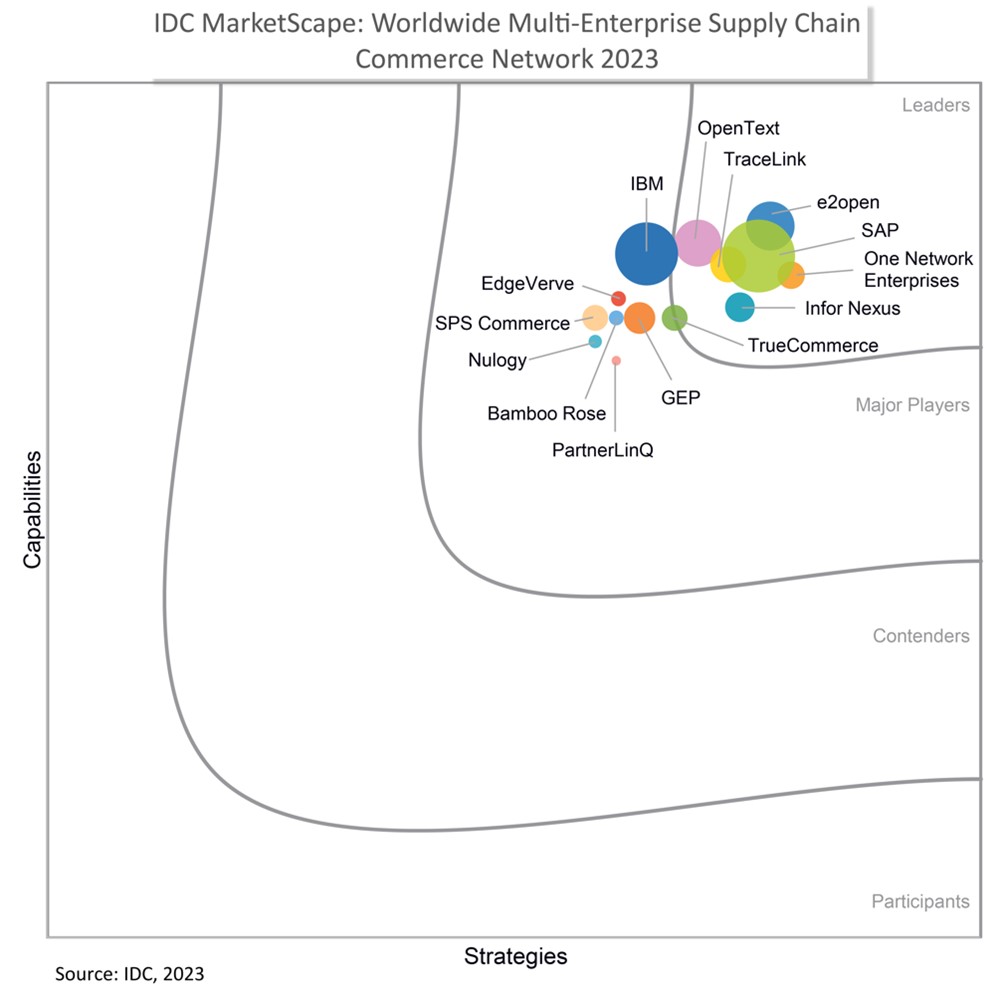
According to the assessment report, “SAP Business Network is a comprehensive B2B collaboration platform that connects people, processes, and systems across multiple enterprises, digitizing transactions and creating transparent, resilient, and sustainable supply chains.”
The report highlights these SAP strengths:
- Depth and breadth of product features, functionality, future road map covering all major B2B collaboration categories (indirect, direct material, MRO logistics, financial, services, sustainability), and scenarios in an end-user, persona-based manner
- Integration and extensibility capabilities including integration between SAP ERP, SAP procurement modules, and other applications (other ERP, SCAM, and customer applications) and technologies (machine learning, AI, blockchain) through SAP Business Technology Platform
- Global adoption and breadth of collaboration among the industry’s largest, highly adopted B2B collaboration platforms, enabling trading partners to collaborate in real time
- Ongoing efforts to harmonize commerce, asset intelligence, and logistics continue to enhance the power of the connected economy.
Thank you to our customers and my colleagues for collaborating on this fantastic win.
Customer Success StoriesAl Dahra, one of the world’s largest agribusiness logistics companies, manages food and animal feed supply chains from its home in the United Arab Emirates (UAE) to countries around the globe. Learn how the company uses SAP Business Network to gain greater visibility into daily operations and as its digital solution to connect the company with its partners and clients.
Building material manufacturer Heidelberg Materials AG knew that visibility across its supplier base was key to enabling the smart decision-making that would help it improve financial performance while meeting sustainability goals. See how it achieved this by harmonizing its procurement processes across its operations with SAP Ariba solutions.
Watch how Chobani, America’s top Greek yogurt brand, uses SAP Business AI embedded in SAP Concur solutions to fully automate its expense processes.
BT Group aims to be the world’s most trusted connector of people, devices, and machines. Read how it overhauled its HR processes with the help of SAP Fieldglass solutions to deliver a modernized, connected colleague experience.
Register for SAP Concur FusionIf you’re lucky enough to attend SAP Concur Fusion this year, don’t miss my colleague Etosha Thurman, chief marketing & solutions officer for SAP Intelligent Spend and Business Network, presenting in the keynote. She will be demonstrating transformative AI in SAP Concur travel, expense, and invoicing solutions, and how we’re creating a world where travel and expenses can practically manage themselves.
Jeff Collier is chief revenue officer for SAP Intelligent Spend and Business Network.
*Source: “IDC MarketScape: Worldwide Multi-Enterprise Supply Chain Commerce Network 2023 Vendor Assessment,” by Simon Ellis, December 2023, IDC #US49948423.
Get weekly news highlights from the SAP News Center Subscribe to our newsletterSAP Accelerates Seagate Technology’s Digital Evolution with SAP S/4HANA
WALLDORF — SAP SE (NYSE: SAP) today announced the successful launch of SAP S/4HANA and the SAP BW/4HANA solution at Seagate Technology Holdings plc (NASDAQ: STX), a leading innovator of mass-capacity data storage solutions.
It will modernize the company’s enterprise resource planning (ERP) system and benefit nearly 30,000 global employees through integrating advanced functionalities, such as enabling global manufacturing, supply chain and finance business processes. This achievement signifies the third crucial phase in Seagate’s digital transformation journey, complementing SAP Integrated Business Planning for Supply Chain and SAP SuccessFactors solutions.
Get ready-to-run cloud ERP that delivers the latest industry best practices and continuous innovation Learn moreSeagate embarked on this transformative path in 2021, transitioning from its legacy systems to embrace SAP S/4HANA, SAP SuccessFactors, and SAP Integrated Business Planning for Supply Chain.
“We chose SAP solutions for our integrated ERP landscape because its strategy closely aligns with our own: to implement a foundational platform on which the business can scale and grow,” said Grace Liu, senior vice president and chief information officer at Seagate.
Seagate’s leadership recognized the limitations of its existing ERP, prompting the need for an integrated platform to keep pace with evolving business models. SAP solutions address these challenges, offering an integrated ERP landscape with centralized business rules and roles. The implementation aims to enable unified global reporting, overcoming hurdles posed by diverse data repositories and laying the foundation for scalable growth while minimizing total cost of ownership (TCO).
The go-live phase was executed efficiently, without operational disruptions, reflecting SAP’s commitment to a smooth transition. Seagate’s reliance solely on the SAP Value Assurance program underscored the efficiency of collaboration, while the use of cloud application services for pre-go-live testing ensured a robust launch.
Seagate’s move to SAP S/4HANA will provide the company with significant improvements in supply chain management, manufacturing execution, and even ongoing transformation. This recent go-live highlights the transformative power of SAP’s innovative solutions and strategic guidance in driving digital transformation for its customers.
Visit the SAP News Center. Follow SAP at @SAPNews.
Media Contact:
Bridget Carroll, +1 (267) 615-3589, bridget.carroll@sap.com, ET
SAP Press Room; press@sap.com
This document contains forward-looking statements, which are predictions, projections, or other statements about future events. These statements are based on current expectations, forecasts, and assumptions that are subject to risks and uncertainties that could cause actual results and outcomes to materially differ. Additional information regarding these risks and uncertainties may be found in our filings with the Securities and Exchange Commission, including but not limited to the risk factors section of SAP’s 2022 Annual Report on Form 20-F.
© 2024 SAP SE. All rights reserved.
SAP and other SAP products and services mentioned herein as well as their respective logos are trademarks or registered trademarks of SAP SE in Germany and other countries. Please see https://www.sap.com/copyright for additional trademark information and notices.
CEV Technologies and SAP Fuel E-Mobility Revolution in Croatia’s Retail Sector
Ranked among the world’s top 20 eco-friendly nations, Croatia aims to prosper in a low-carbon economy. However, such success demands major investments in building an energy infrastructure and increasing renewable resources – two criteria that the customer experience can help address.
Throughout Croatia, some businesses are venturing to a first in the European Union: offering customers charging services for electric vehicles (EVs). But this “charge while you wait” initiative isn’t just about attracting new customers – it’s about integrating eco-friendly practices into daily routines for a more sustainable future.
According to Ivica Blažević, CEO and founder of CEV Technologies d.o.o., “While automakers promise a more-electric future, people are interested in EVs only if they reduce fuel costs, offer convenience in refueling, enhance driving experiences, and demonstrate significant environmental contributions. This latest addition to the customer experience proves how businesses across various industries can play a pivotal role in delivering that vision.”
Greening the Customer Experience with E-MobilityThe transition to a low-carbon economy presents an opportunity for Croatia to enhance citizens’ lives by reducing reliance on fossil fuels and investing significantly in renewable energy sources such as wind, solar, and hydroelectric power. The country also emphasizes energy efficiency in buildings and industries, implementing regulations to curtail energy consumption.
One initiative gaining traction thanks to Croatia’s growing desire to offer charging stations is sustainable transportation. By encouraging electric vehicle usage while advancing public transport initiatives to reduce fossil fuel dependency, the country can better align with European Union directives and foster a greener economy that champions people, businesses, and communities.
SAP partner CEV Technologies, a rapidly growing international charge point operator and e-mobility service provider, aims to support these initiatives. The company offers bespoke e-mobility and smart energy solutions, intending to assist customers in leveraging EV charging solutions and green energy more effectively.
For sustainability-focused countries like Croatia, CEV Technologies sees enormous promise in developing solutions for many industries, including retail, hospitality, and fleet management. And it wants to apply its deep expertise in EV charging technology to create innovative e-mobility features. To realize this aim, CEV Technologies cemented strategic business relationships to help co-create smooth, intelligent, and automated charging experiences.
“In our partnership with SAP, we develop innovative and intelligent charging experiences for our customers. The focus is on integrating the charging process with individual business models to establish value-creating, end-to-end scenarios,” Blažević explains.
Drive the transition to sustainable and convenient electric mobility with SAP Learn moreTo realize the potential of convenient charging within the customer experience, CEV Technologies implemented the AI-enabled capabilities of the SAP E-Mobility solution. It can support various scenarios for vehicle charging network construction, management, billing, and reimbursement. In addition, the solution helps optimize renewable energy production through greater transparency into costs, the charging process, and network usage.
But even more stunning is the opportunity to overcome one of the most significant challenges in the e-mobility market: simplifying the payment process at charging stations. Often, this involved a convoluted process requiring membership in exclusive charging networks, managing prepaid accounts, or navigating multiple apps. Now, CEV Technologies is enabling direct credit card payments at charging stations. This innovative move streamlines the charging and paying process, eliminating the obstacles to pushing e-mobility closer to a user-friendly, universally adaptable experience.
In return, achieving public, private, and commercial sustainability goals is within reach. Companies can develop, integrate, and adapt business models that address all types of customer needs and sustainability expectations with outcomes including:
- Speeding up onboarding of charging stations by three times through the use of templates
- 30% less effort when setting up relevant infrastructure, including back-end systems
- 20% faster ramp-up of charging stations
For Croatians, these benefits of e-mobility could bring more value to their everyday lives. Take, for example, a typical commute home from work. The navigation system of an EV can route you toward a charging station in a familiar location and effortlessly reserve it through a loyalty platform.
Plugging your EV into the charging point, you initiate the charging process on your phone and decide to capitalize on offers for a complimentary coffee and other exclusive in-store promotions. After checkout, you receive a comprehensive e-mail overview of your charging session and shopping experience and a free charging voucher for a future purchase.
While this customer experience epitomizes the harmonious fusion of technology and convenience, it also shows how a collective dedication to creating a greener, more connected future can positively impact individuals, communities, a nation, and even the world. And more important, the appeal of a straight-forward payment method that is reminiscent of traditional fueling stations might have an even more far-reaching impact on potential drivers’ willingness to adopt electric vehicles.
Aligning Businesses with Societal StewardshipCroatia is striding more confidently toward a low-carbon economy as EV charging services become more integrated with the customer experience. Thanks to a country’s vision and CEV Technologies’ innovative solutions, companies across all industries can join this eco-shift by offering products along with an integrated sustainable lifestyle.
Korbinian Koblitz is business development lead for Automotive at SAP.
Sign up to receive weekly news highlights from the SAP News Center Subscribe to our newsletterA Clear Path to Digital Supply Chain Excellence with SAP Preferred Success
In today’s fast-paced and interconnected world, supply chain management plays a pivotal role in determining the success of a business. The digital transformation of supply chain processes has become imperative to remain competitive and agile in the market. SAP offers a powerful suite of tools as well as services and support plans to help businesses harness the full potential of their digital supply chain.
In this article, I explore how forward-thinking businesses can integrate guidance plans into their software strategies to advance the transformation of their digital supply chain in a fast-paced business environment.
Embracing the Digital Supply Chain RevolutionTraditional supply chain models have undergone a significant transformation through the integration of digital technology. Now, companies have access to real-time data, advanced analytics, and automation, facilitating informed decision-making processes. A digital supply chain boosts efficiency, cuts costs, and mitigates risks. However, a potent software solution is just part of the equation. Comprehensive innovation requires continuous upskilling of the workforce, a clear vision, and ongoing transformation.
Yet, businesses face challenges throughout the entire software lifecycle. Supply chain professionals juggle day-to-day tasks, envision the future, and manage critical steps. This demands strategic foresight and product expertise, a challenge many customers grapple with.
A reliable helping hand, like the SAP Preferred Success plan, can become invaluable. This advanced plan can aid in digitizing the supply chain, offering guidance for implementing and optimizing SAP Best Practices. The goal? Helping businesses extract maximum value from technology investments.
Here are a few key aspects that the SAP Preferred Success plan can offer customers in their digital supply chain journey.
A Personalized PlanImagine collaborating with your organization’s personal squad of SAP wizards. They’re not just experts; they’re partners that can craft a tailor-made plan for your digital supply chain ambitions. It’s like having a strategic road map exclusively for you, helping to ensure every move aligns with your business objectives. Say goodbye to uncertainty headaches because the how, what, and when can be crystal clear. This clarity is crucial as your project partner wraps up and reliance shifts to your in-house supply chain and IT teams. SAP Preferred Success helps eliminate any uncertainty by providing a guide to help navigate the digital landscape seamlessly.
Tailored GuidanceYour SAP Preferred Success counterpart can step into the role of your personalized guide, helping to deliver tailored advice and best practices precisely when you need them. It can go beyond just implementing SAP solutions; it’s about harmonizing them with tried-and-true best practices. What sets this apart is the proactive nature of the guidance. Think of it as a well-orchestrated symphony of checks and advisories by your customer success partner and delivered by our seasoned experts.
Fast-track the value of your cloud investment with SAP Preferred Success Learn more Accelerated Adoption and Continuous ImprovementThe SAP Preferred Success plan is meticulously designed to help fast-track the adoption of SAP solutions and facilitate a quicker time-to-value. In the digital era where agility and speed reign supreme, there’s no room for guessing or waiting – it’s full speed ahead. And this isn’t a one-time sprint; it’s a commitment to continuous improvement, learning, and the refinement of your processes over time, well after your first go-live.
Technology evolves rapidly, and SAP Preferred Success can become your compass to stay ahead of the curve. How often have you heard customers wondering, “Are we aware of the latest capabilities or features? Should we be doing more with our solution?” The guidance embedded in the plan strategically helps in answering those questions. It’s about thriving in an ever-evolving digital landscape, not just avoiding obsolescence.
Data-Driven Insights for Feature AdoptionSAP Preferred Success can take the lead in leveraging the robust data and analytics capabilities within SAP solutions. This can give you actionable insights and helps guide you towards the most relevant features for your business.
Determining which features are truly relevant and whether they make sense for your business can be a puzzle. Add the frequent releases of new features in the cloud and staying in the loop and it becomes more challenging. SAP Preferred Success can act as your data-driven guide, helping to align features with business objectives so that you use only those enhancing effectiveness.
Access to ExpertsThere comes a point where the brilliance of your supply chain teams and IT experts might need a little extra support. SAP Preferred Success can provide access to SAP experts that help navigate challenges effectively. With SAP Preferred Success, you can get dedicated time with the precise subject-matter expert needed to help address your concerns and seek guidance.
Risk MitigationWith SAP Preferred Success, risk mitigation in digital transformation can take center stage. You can benefit from enhanced incident handling in service-level agreements, which can significantly reduce risks during implementation and post go-live. Consider it your proactive protection for a smooth journey through the complexities of digital evolution.
Seamless Transformation with SAP Preferred SuccessDigitalization is not just a choice but a necessity. SAP Preferred Success emerges as a guiding light for businesses keen on transforming their supply chain operations. Its advanced assistance can enable seamless transformations, enhanced guidance, and expertise, all while helping to alleviate stress and empower your supply chain and IT teams.
And there’s a commercial model. Imagine SAP Preferred Success is like a subscription to your favorite streaming service, with no hourly charges and no paperwork for guidance or ad-hoc questions. Your supply chain subscription covers everything, enabling a stress-free focus on the transformation journey without administrative complexities.
Visit us online or contact your local SAP representative to learn more about SAP Preferred Success for supply chain management solutions from SAP.
Kiron Satyavarapu is global solution owner for SAP Preferred Success at SAP.
Follow SAP News on LinkedIn Connect with usPekka Ala-Pietilä Proposed by SAP Supervisory Board as Designated Successor to Chairman Hasso Plattner
WALLDORF — The Supervisory Board of SAP SE (NYSE: SAP) has nominated Mr. Pekka Ala-Pietilä to stand for election as a new member of the Supervisory Board and proposes Mr. Ala-Pietilä as the designated successor to Chairman Prof. Dr. Hasso Plattner. Mr. Ala-Pietilä will stand for election for a two-year term at the next Annual General Meeting and, if elected, will assume the role of chair.
Pekka Ala-Pietilä / SANOMA Kuva: Heidi Piiroinen
SAP and Dr. h.c. Punit Renjen have mutually agreed to part ways because of a difference in perspective on the role of SAP Supervisory Board chair, which Punit Renjen was designated to assume. Punit Renjen has chosen to resign his mandate on the SAP Supervisory Board with effect from the end of SAP’s Annual General Meeting on May 15, 2024.
Pekka Ala-Pietilä (67) has an illustrious track record in European innovation and technology and is well-positioned to lead SAP’s ongoing successful transformation. He was President of Nokia Corporation from 1999–2005 and a member of the SAP Supervisory Board from 2002–2021. He was the Chairman of the EU Commission’s High-Level Expert Group on Artificial Intelligence from 2018-2020 and chair of Finland’s Artificial Intelligence Programme from 2017-2019. He currently serves on several European corporate boards, including as Chairman of the Supervisory Board of the Dutch multinational location intelligence company HERE Technologies. Mr Ala-Pietilä holds honorary Doctorates in Technology from Tampere University of Technology and in Science from the Aalto University School of Business. He lives in Helsinki.
“After two decades at the helm of SAP SE, the company I’ve nurtured from its inception, ensuring a successful handover of the leadership baton is paramount to me and crucial for SAP’s continued success,” said Prof. Dr. Hasso Plattner, who has served as Chairman since 2003. “In Pekka Ala-Pietilä, I recognize a leader who not only possesses a profound understanding of our industry and the intricacies of European SE governance, but also one who has been a steadfast ally through many of SAP’s pivotal moments. Before looking ahead, let me also express my deep gratitude to Punit Renjen for his efforts and contributions. His energy level and dedication have been exceptional from the beginning. As we welcome Pekka Ala-Pietilä, I am filled with confidence that SAP’s Supervisory Board is in the most capable hands. His vision and well-measured approach are exactly what SAP needs to safeguard its future and ensure its ongoing success.”
Pekka Ala-Pietilä said, “I am grateful to the Supervisory Board of SAP and to Hasso Plattner for the opportunity to rejoin this dynamic European technology leader at such a pivotal time. Thanks to the great people at SAP, the company has set the global standard for enterprise technology for more than 50 years and is now a trailblazer in developing and deploying relevant, reliable, responsible Business AI that will fundamentally change the way business runs. I look forward to working together with colleagues old and new to build on SAP’s track record of delivering revolutionary technology that drives real results.”
Visit the SAP News Center. Follow SAP at @SAPNews.
Get the highlights from the SAP News Center delivered to your inbox weekly Subscribe nowAbout SAP
SAP’s strategy is to help every business run as an intelligent, sustainable enterprise. As a market leader in enterprise application software, we help companies of all sizes and in all industries run at their best: SAP customers generate 87% of total global commerce. Our machine learning, Internet of Things (IoT), and advanced analytics technologies help turn customers’ businesses into intelligent enterprises. SAP helps give people and organizations deep business insight and fosters collaboration that helps them stay ahead of their competition. We simplify technology for companies so they can consume our software the way they want – without disruption. Our end-to-end suite of applications and services enables business and public customers across 26 industries globally to operate profitably, adapt continuously, and make a difference. With a global network of customers, partners, employees, and thought leaders, SAP helps the world run better and improve people’s lives. For more information, visit www.sap.com.
Note to editors:
To preview and download broadcast-standard stock footage and press photos digitally, please visit www.sap.com/photos. On this platform, you can find high resolution material for your media channels.
For customers interested in learning more about SAP products:
Global Customer Center: +49 180 534-34-24
United States Only: 1 (800) 872-1SAP (1-800-872-1727)
For more information, press only:
Monika Schaller, + 49 6227 7-40763, monika.schaller@sap.com, CET
Joellen Perry, +1 (626) 265 0370, joellen.perry@sap.com, PT
SAP Press Room; press@sap.com
For more information, financial community only:
Anthony Coletta, +49 6227 7-60437, investor@sap.com, CET
James Dymond, +49 6227 7-61823, investor@sap.com, CET
Follow SAP Investor Relations on LinkedIn at SAP Investor Relations
This document contains forward-looking statements, which are predictions, projections, or other statements about future events. These statements are based on current expectations, forecasts, and assumptions that are subject to risks and uncertainties that could cause actual results and outcomes to materially differ. Additional information regarding these risks and uncertainties may be found in our filings with the Securities and Exchange Commission, including but not limited to the risk factors section of SAP’s 2022 Annual Report on Form 20-F.
© 2024 SAP SE. All rights reserved.
SAP and other SAP products and services mentioned herein as well as their respective logos are trademarks or registered trademarks of SAP SE in Germany and other countries. Please see https://www.sap.com/copyright for additional trademark information and notices.
The Game-Changing Role of Incentive Compensation Automation in the Retail Industry
In the dynamic world of retail, staying ahead means adapting to evolving customer expectations and embracing innovative solutions. The era of omnichannel retailing has ushered in demand for seamless, personalized shopping experiences, compelling businesses to think outside the box to support seamless experiences and minimize friction by providing the right product at the right time in the right place. Moreover, recognizing the intricate dance between employee satisfaction and customer experience, businesses are weaving a narrative where a better employee experience becomes the cornerstone for elevating customer delight.
At the recent NRF event, the world’s largest retail conference, the mantra of “adjust and adapt” echoed through the halls. AI and digital acceleration took the center stage, making innovation the heart of the conversation. Retailers also highlighted a crucial focus on a motivated workforce, emphasizing how an empowered workforce is critical to delivering exceptional customer experiences.
In a landscape challenged by high turnover rates, retailers showcased their commitment to navigating complexity through strategic investments in their most valuable asset – their people. One of the pivotal elements that drives employee motivation and engagement in the retail industry is incentive compensation, where associates are often paid on commission.
During NRF, Daniel Jasper from Neiman Marcus shared insights into how incentive compensation automation transformed the company’s commission payment process. With over 40 stores and a complex commission structure, Neiman Marcus faced challenges in managing incentive compensation. Its previous incentive management system was cumbersome and complex, which led to errors, delays, and frustration among sales associates. Implementing the SAP SuccessFactors Incentive Management solution helped streamline the process, providing real-time monitoring of commission calculations. This allowed Neiman Marcus to identify and resolve issues proactively, resulting in improved accuracy and timeliness of commission payments. “Rather than waiting to hear from associates that something is wrong, we can monitor the calculations in real-time and resolve issues in advance,” said Jasper. This shift has been a game-changer for Neiman Marcus, driving better sales and revenue growth.
Empower sales teams with the tools they need to create effective sales experiences Find out howSAP SuccessFactors Incentive Management is one of the sales performance management solutions in the SAP SuccessFactors portfolio, and it offers a sophisticated platform for tailoring incentive programs to suit the unique needs of retail associates. With powerful analytics, embedded intelligence, and built-in workflows, this solution can revolutionize compensation management. Its intelligent design can not only foster trust but also ignite motivation among store associates. Through a user-friendly mobile app, retail customers can enjoy a comprehensive and easily accessible view of both store and individual performance metrics, promoting transparency and a unified understanding of team dynamics and trends. Personalized recommendations, relevant insights, and interactive monitoring help enhance the user experience, while the mobile app helps ensure that store associates can access their incentives anytime, anywhere, from any device.
The solution’s agility helps facilitate a swift rollout of new and updated compensation plans, offering the flexibility to manage broadly or tailor plans to individual needs. With a steadfast commitment to accuracy and traceability, associates can trust the fairness of calculations, fostering a positive work environment. The effective dating functionalities help further empower organizations, allowing seamless management of associate promotions and transfers.
“Retail businesses more than ever need the ability to design and manage incentive plans that align with ever-changing organizational goals, with a focus on store-level personalization and granularity that allow for improved accuracy and timeliness of commission payments,” said Rahul Iyer, general manager of Sales Performance Management at SAP. “With SAP SuccessFactors Incentive Management, retailers can incorporate key performance indicators, such as sales per hour and units per sale, into their incentive structure. The mobile app can provide visibility and transparency into individual and store performance, effectively motivating and ensuring optimal performance from their associates.”
In essence, SAP SuccessFactors Incentive Management emerges as an indispensable tool, helping to empower retail customers to optimize workforce performance and drive sustained success. Displaying key performance indicators and incentives has proven to be a game changer, helping to drive focus on store and individual performance. The result? Associates are more attentive to customers, guiding them through purchasing decisions and enhancing overall satisfaction.
In the always-changing retail world, success comes down to three things: using better technology, having happy employees, and keeping customers in focus. The story of Neiman Marcus proves that automating incentives can be a game changer. It shows how a motivated and well-connected team can not just boost how things work but also bring in more sales and money.
To stay ahead in retail, you need to be ready for change and invest in both tech and your team. This is a clear lesson for retailers planning for the future. Learn more about how sales performance management can simplify the retail industry. To learn more about how sales performance management solutions can support your organization, visit the sales performance management product page on sap.com.
Kevin Coxwell is vice president of GTM for Sales Performance Management at SAP.
Connect with SAP News on LinkedIn Follow usHow Generative AI for Business Is Creating a New Playbook for Value
Every technology conversation today centers around the transformative potential of generative AI for the future. But the reality is, it’s already happening today. And while its capabilities are noteworthy, the real promise of generative AI for business is not what it can do so much as the value it can create.
In my role at SAP, I speak to business leaders all the time about the value that generative AI can add to their business in ways they might not even realize, and I hear countless stories about how it is already starting to do that. One of my favorite examples is one that SAP announced last week in an arena that is near and dear to me: finding and developing the next generation of star athletes.
See what SAP is building with generative AI Explore nowAs someone who used to play and coach basketball in Australia, I have had a lifelong appreciation of coaching but also of scouting talent. Scouting is a discipline where art truly meets science, where experience and intuition are strengthened by the objective reality revealed by data.
While professional scouting has been around for a very long time, as more data on players becomes available, more teams are using it as a competitive advantage. But that’s not as easy as it sounds. While the sophistication of scouting reports is impressive, the process of creating and using them effectively has never been efficient. When you consider how many potential young star athletes there are in the world, you can see how this would create an enormous amount of scouting reports to go through in a short period of time. The problem gets even more daunting when you consider that they are written in different languages and in different writing styles.
In short, it’s exactly the kind of challenge that generative AI for business is built to solve.
For proof of that, just look at the German professional soccer clubs FC Bayern Munich and Hertha BSC. For a long time, both clubs have employed talent scouts who travel the world watching matches and collecting reams of data about players in the hope of finding the next great star before any of their competitors do.
But to show how this could be done better, SAP collaborated with FC Bayern Munich and Hertha BSC on a prototype. It uses generative AI to create automated summaries and recommendations of the reports created by their different scouts in different parts of the world and makes them available to club executives simply by asking for them in their natural language.
For example, imagine a German-speaking manager of the club being able ask for a key summary in 100 words or less of a scouting report on a young player who was scouted in Argentina and written in Spanish. That same manager can also ask it to compare two players based on their just their defensive skills or endurance. While translation apps can translate an entire report from Spanish to German, it takes a large language model (LLM) to create these summaries and competitive analyses on demand using natural language commands — essentially just the information that club executives really need to make informed decisions fast.
This is exactly what the prototype allowed these clubs to do. It took a time-consuming task and automated it in an intelligent way to make it useful. As a result, we will soon be rolling out this capability as part of our sports management suite, SAP Sports One, which has already been helping athletes and teams get better results in their sport while also creating better experiences for their fans since 2015.
Why should business leaders care about better scouting reports? Two reasons: first, because they face many of the same challenges in their own business, needing to harness the power of their data quickly on demand for competitive advantage. And second, because generative AI is not just a specific solution for a specific problem. Its true magic is that it is also scalable across an entire enterprise to address other business needs, from financing and supply chain management to procurement, travel, trainings, and more. For example, when generative AI is combined with SAP Business Technology Platform (SAP BTP), businesses have the ability to write code, keeping their core clean and building generative AI extensions to further scale impact.
There is simply no doubt that data is the playbook of champions in sports. But it is also creating a new playbook of value in business. And with the era of generative AI for business only just beginning, I cannot wait to see what other amazing innovations will move from imagination to reality — and all of the value that they will create.
Scott Russell is a member of the Executive Board of SAP SE.
SAP Sports One: Get insights about your players and your team with real-time analytics Learn moreEquipping the Next Generation of Underrepresented Talent for a Career in Tech
“I just never saw myself in tech.”
This is what I heard during my discussion with the first cohort of SAP’s digital skills initiative, a program that helps equip underrepresented and underserved groups for a career in the tech industry through participation in a free SAP Certification course.
How could it be that in a time when companies need to find talent quickly to fill the need for technically skilled roles – a need that is becoming more urgent by the day – there is an entire population of determined, driven people who feel as though they do not belong in the tech industry?
The Current State of Diversity in TechnologyThe numbers speak volumes: only 27% of all computing-related jobs are held by women. Only 3% of those jobs are held by Black women and 1% are held by Latina women. For me, it has always been impossible to ignore the lack of representation in the tech industry. I am acutely aware of when I am the only woman in the room – let alone the only Black woman.
But this is changing. Companies have begun implementing diversity-forward hiring practices to try to minimize barriers for populations that have historically been overlooked. The percentage of employers with diversity recruiting efforts rose from 56% in 2016 to 88% in 2021. Though there is now targeted backlash, numerous employers remain committed to their diversity, equity, and inclusion (DE&I) goals for the workforce.
These initiatives have proven to be important to younger generations. In a few years, millennials and Gen Z will make up the majority of our workforce – and they want to work for companies that align with their values. A 2022 survey from the National Association of Colleges and Employers (NACE) found that 76% of recent graduates indicated that diversity, equity, and inclusion efforts were “very important” or “extremely important” when considering their future employers.
Helping Underserved Groups Break into Tech Accelerate your career with our digital skills initiative Learn moreIf we want diverse workforces, we must support and create targeted channels to source diverse talent. It is imperative that these groups – including women, people of color, veterans, and others – are given the resources to excel in high tech. I have seen firsthand how our digital skills initiative is making an impact on individuals and their communities, working to ensure that talent from all backgrounds can participate in this exciting era of technological innovation. At SAP, we offer training on products like SAP S/4HANA Cloud and SAP ERP, whether through programs like the digital skills initiative or on SAP Learning Hub, helping anyone interested in jump-starting their career in tech.
Without diverse perspectives, we leave out too many pieces of the puzzle to see the big picture. This deficit is particularly obvious in technology, given its influence on everything from how we shop to how we govern. It is unsustainable to expect lasting market viability from products that are developed by and marketed to one type of person. Put simply, employing diverse talent is essential to long-term success.
How Companies Can Recruit Diverse TalentFor companies that are looking for the next pool of employees to solve today’s business challenges, it is time to consider non-traditional avenues of talent, like graduates from SAP’s digital skills initiative. Each cohort comes equipped with SAP Certification, self-motivation, and a strong work ethic. This is a special opportunity to pull from a curated group of strong candidates, not just because of their new skills but because of demonstrated curiosity and drive that is not easy to find.
SAP makes these trained and certified candidates available to recruiters at no charge. Want to get access to SAP-certified, ready-to-hire talent? Interested in adopting a cohort? Contact us to see how you can start hiring and get involved.
Register for the Digital Skills Initiative as a ParticipantIf you are interested in expanding your career opportunities by learning in-demand skills and achieving an SAP Certification free of charge, apply for the digital skills initiative using the applicant guide. This is a fantastic opportunity for those who want to make a career switch to tech.
To those who never pictured themselves in the tech industry, picture it. There is a place for you. Take this as a sign to invest in yourself and create a new path to success.
Making an Impact on Future GenerationsWhen I talked with this first cohort of the digital skills initiative, I saw how they take great pride in their certification. For some, these new skills will prove to be life-changing.
My goal is to support initiatives that aim to ensure that everyone, from all backgrounds, can pursue their interests in finding a career in tech. When we leave these doors closed, we not only rob those shut out of the opportunity, but all of us from the creativity, perspectives, and outcomes they could deliver.
I am incredibly proud of SAP’s work in empowering people to pursue a career in technology. I believe that we are developing the future of innovation through programs like the digital skills initiative, and I cannot wait to see how similar programs will evolve in the future.
If you are an NGO, university, or an SAP partner or customer, contact us at partners.digitalskills@sap.com to learn more. If you are interested in applying to the digital skills initiative, create an SAP account to start your journey.
Etosha Thurman is chief marketing and solutions officer for Intelligent Spend and Business Network at SAP.
Get the latest and greatest delivered to your inbox every week Subscribe to the SAP News Center newsletterSAP’s Source-to-Pay Solution Strategy Focuses on Customer Success
Source to pay is a critical process for every organization. In a constantly evolving business environment, how does SAP continue to support this process with its portfolio of SAP Ariba Procurement solutions? Simple. We listen to our customers, track market signals, and deliver innovative technology designed to help businesses achieve the best possible outcomes.
This is our long-standing strategy, and we have no plans to change something that clearly benefits our customers. No one knows this space better than SAP. The introduction of SAP Ariba solutions more than 25 years ago revolutionized procurement processes for businesses. We’ve taken the investment, innovation, and integration across our product line to deliver a complete portfolio of solutions. SAP Ariba is the future of procurement, and everything procurement at SAP is now SAP Ariba.
SAP also understands that what works for one business, one industry, or one geography, may not play in another. Businesses need to choose the right source-to-pay solution partner – with a platform and ecosystem poised to ensure their procurement teams have the tools and actionable data they need to succeed in their increasingly essential and strategic roles.
As we’ve listened to our customers and the market, here is what they have told us are their critical requirements:
- The ability to see and analyze spend across all categories
- Intelligence-driven category management that leverages analytics, spend data, and market intelligence
- Robust contract management functionality
- Automated management of external labor and services
- Practical AI use cases that drive efficiency across the procurement process
Within the source-to-pay landscape, SAP delivers integrated solutions to help manage all forms of spend. Our solutions comprise a full suite of enterprise-level functionality spanning sourcing, category management, buying and invoicing, services procurement, supplier relationship management, contract management, and spend analytics. Additionally, we enable businesses to connect with suppliers across 190 countries via SAP Business Network.
As you evaluate source-to-pay solution partners, consider the following:
- The source-to-pay landscape is changing quickly. Stay current. Today, everyone’s perspective on the source-to-pay technology landscape is vastly different than it was even half a year ago. Be mindful of how your business is evolving, and assess providers based on how their vision and road map align with your future needs.
- “Best of breed” doesn’t always mean “best for your business.” SAP has demonstrated that in addition to the breadth of our solutions for source to pay, we can enable businesses to address their global requirements, handle high transaction volumes, and integrate into many back-end ERP systems.
- SAP’s ecosystem of partners enables us to deliver advanced functionality to our customers. We remain committed to ongoing development of core, native capabilities across our source-to-pay portfolio. At the same, our strategy is to augment this development in some areas with innovation and advanced functionality through partners. This allows us to add significant value rapidly for our customers.
- Having access to a global network of suppliers is a game changer. SAP Business Network, which can extend the source-to-pay process beyond the walls of any business, can give our customers unmatched access to a global marketplace of trading partners. In 2023, annual commerce on the network reached US$5.3T, with 746M B2B transactions.
SAP has demonstrated its ability to balance product modernization, innovation, and our larger vision to enhance procurement capabilities in SAP S/4HANA with delivery of cutting-edge innovations that benefit our customers. Here’s how we’re addressing the critical requirements mentioned earlier.
The Ability to See and Analyze Spend Across All CategoriesIn our conversations with customers all over the world, this is one of their top asks. They are also asking for greater visibility into spend that impacts their sustainability goals.
Last fall we unveiled SAP Spend Control Tower, which offers advanced AI features and the ability to see across all spend in SAP cloud ERP solutions, SAP Ariba solutions, and SAP Fieldglass solutions. Visibility into data from SAP Concur solutions, SAP Business Network, and non-SAP solutions is also on our road map. This can enable businesses to uncover cost-saving opportunities and process improvements. SAP Spend Control Tower is expected to be available in the second half of 2024. See a demo to learn more.
Intelligence-Driven Category Management Improve business outcomes with intelligent category management Learn moreIn our 2022 and 2023 research with Economist Impact, category management was ranked as a top driver of digital transformation in procurement. Driven by this and our extensive market analysis, SAP released the SAP Ariba Category Management solution last summer, empowering businesses to realize better results in this critical area.
The solution can streamline category strategy development, execution, and monitoring at scale. Additionally, it can enable organizations to optimize source-to-settle processes with embedded analytics enriched with spend data and market intelligence. Watch this demo.
Robust Contract Management FunctionalitySAP understands the importance of balancing risk and profitability within source to pay. To provide the additional advanced contract management capabilities our customers need, we entered into an expanded partnership with Icertis in 2022. This partnership helps ensure a joint product road map and deeper technological integration between SAP and Icertis solutions.
For SAP customers, integration with Icertis Contract Intelligence can allow them access to best-in-class innovations such as smart authoring, AI-assisted risk identification, obligation management, contract-driven insights for decision support, and the ability to have one contracting system for both sales and procurement – a capability no other source-to-pay solution offers.
Based on user evaluations, SAP Ariba solutions received these leader badges from G2.
Automated Management of External Labor and Services
Sometimes overlooked within the source-to-pay discussion is services procurement. That’s changing. A 2023 Future of Work Exchange report said 72% of enterprises plan to focus more extensively on ROI in their services procurement and statement-of-work management activities. The goal is to manage external labor and services strategically, applying the same process rigor there as with any other procurement category.
SAP Fieldglass solutions can enable you to transform how you find, engage, and manage contingent workers and services providers to maximize business value.
Practical AI Use CasesSAP is embedding AI throughout the spend management process to help eliminate the mundane and elevate the strategic. Current use cases range from auto-complete and recommendation engines leveraging traditional AI and machine learning, to generative AI functions that can automate complex procurement processes. In 2024, we will continue to develop SAP Business AI use cases that help drive efficiency across spend management processes. Find out more about new generative AI scenarios.
In the Words of Our Customers…More confirmation that SAP’s source-to-pay strategy is sound can be seen in the results we’re delivering for our customers. Here’s what they’re saying:
“[SAP Ariba] has no comparison in the market. No other software is even close. Best part is, once our supply chain executives get using it, they simply fall in love with it…Savings are immense.”
Verified SAP Ariba user, via TrustRadius“[SAP Ariba] stacks up by being a great, user-friendly platform that is easy to use.”
Verified SAP Ariba user, via TrustRadius SAP Ariba Sweeps the 2023 TrustRadius “Best Of” AwardsEach year, TrustRadius issues awards to vendors who provide the best offerings in their category. In 2023, SAP Ariba solutions won all four awards based on customer satisfaction ratings.
Leaning In to Our Source-to-Pay Strategy
As we’ve seen in the input from our customers, as well as assessments from analyst organizations like IDC, SAP’s source-to-pay strategy is producing solutions that help businesses run better. And that is SAP’s mission, plain and simple. In 2024, we’ll lean in to deliver solutions and innovations that continue to outpace the competition across the source-to-pay technology landscape.
Baber Farooq is senior vice president and head of Market Strategy for SAP Procurement Solutions.
Salvatore Lombardo is senior vice president, chief product officer, and head of Engineering for SAP Procurement.
SAP Experts at the Forefront of Quantum Computing Exploration
As quantum computers evolve, SAP is among the leading companies exploring how this technology can disrupt business norms for unparalleled innovation and opportunities.
While it might be early days given hardware limitations, SAP experts are in full-on discovery mode, working with customers and partners at quantum-related industry associations.
How Quantum Computers Can Solve Real-World ProblemsSAP experts are spearheading several working groups as members of the Quantum Technology and Application Consortium (QUTAC). QUTAC is a German-based group focused on applying quantum technology for business value in various industries. In one group, the team is modeling potential use cases using quantum computing for optimization and machine learning in production and logistics. In another, they are researching various quantum computing systems to compare strengths and weaknesses for use case consideration.
“We’re trying to understand how quantum computers can solve real-world business problems,” said Andrey Hoursanov, head of Quantum Exploration at SAP. “In collaboration with other QUTAC members, we’re identifying which next new quantum computing use cases will be most valuable for organizations, sourcing information from external research and our own expertise.”
Working Groups Take On the Quantum ChallengeQuantum computers can speed up computationally intensive tasks, promising the delivery of better and faster solutions for specific classes of problems. Much of this exploratory phase consists of benchmarking available quantum technologies, such as available machine capabilities by qubit size to handle industry-specific problems. Questions include what special properties each kind of quantum system offers, as well as their suitability and scalability to address business relevant challenges. For example, some teams are focused on applying the unique advantages of quantum computers to speed up and improve anomaly and fraud detection, cost optimization for cloud providers, image recognition, and data synthesis.
“Through open discussions with different companies that are participating in these working groups, we’re discussing potential road maps for innovation,” said Peter Limacher, leading researcher of the Quantum Exploration team at SAP. “People are very interested in quantum computing, and we want to make sure that we prioritize use cases that have the greatest potential to deliver business value.”
Limacher was involved in a working group that recently published a peer-reviewed paper based on a study of quantum computing approaches for multi-knapsack optimization, meaning one recurrent task that several industries face. In addition to the high demand for better quantum hardware, the paper concluded that the industry needed more and improved quantum optimization algorithms for multi-knapsack and other problems.
SAP Is Committed to Meet Enterprise-Grade ExpectationsTo be clear, there’s a significant gap between the performance of current quantum computer hardware and the many variables that require scaling quantum-driven solutions in actual industry settings. Forward-thinking innovators are moving ahead despite the chicken and egg conundrum.
“To meet our customers’ expectations, we cannot wait until full-fledged quantum computers are completely operational,” said Hoursanov. “Through collaborative use case discovery and testing, we’ll be prepared to provide customers and partners with access to the latest technology as soon as it makes sense for them.”
Just as standardized frameworks for classical computers evolved, so will quantum computers. There are no standards yet, and every quantum computer design has advantages and disadvantages. For example, superconducting quantum computers require low temperatures and protection from electromagnetic waves to prevent qubit degradation. Eventually, researchers will be able to match targeted use cases to the best-suited quantum systems and software application developers will apply quantum programming to any machine.
Collaboration Unlocks the Quantum AdvantageSAP is also a member of the European Quantum Industry Consortium (QuIC), a non-profit organization focused on developing the quantum industry and ecosystem for the region and others including North America, Japan, and ANZ. In addition to her role as research project director at SAP, Laure Le Bars is president of QuIC.
“Our members consist of companies of all sizes that create and use quantum technologies, including hardware manufacturers and software developers. They’re working together with members in government policymaking, academia, standardization bodies, and others to help spark market growth from quantum advantage,” said Le Bars. “In the future, we’ll have hybrid architectures with a combination of classical and quantum computers using their respective strengths to achieve business objectives.”
Susan Galer is a communications director at SAP. Follow her @smgaler.
Photo courtesy of SAP employee Renan d’Avila
Connect with SAP News on LinkedIn Follow usSAP’s Journey to Net Zero 2030
The world faces increasing climate and social crises. Comprehensive assessments have given us a deeper understanding of the science and the role of industry. As a global technology company supporting the vast majority of the world’s business, SAP needs to lead from the front with our ambitions and actions. That is why SAP has committed to achieve net-zero emissions across our value chain by 2030.
Since 2009, SAP has been on a sustainability journey with the objective to create positive economic, environmental, and social impact within planetary boundaries. Along the way, we have learned a great deal about measuring economic, social, and environmental performance and integrating sustainability into our business strategy. Central to this effort has been a continuous effort to decarbonize our business. Setting ambitious targets and leveraging digital solutions have proven crucial.
Raising our ambition to achieve net-zero emissions is a key element of our approach to sustainability, which looks across the interconnected areas of holistic steering and reporting, climate action, the circular economy, and social responsibility.
What Does Net Zero Mean?Net zero is a state where the greenhouse gases going into the atmosphere are balanced by removal out of the atmosphere. Corporate net-zero pledges have gained significant traction as half of the world’s largest companies, representing an annual aggregate revenue of US$27 trillion, are committed to net zero.
Together, we can enable a future with zero emissions, zero waste, and zero inequality Learn moreThere are a number of definitions of net zero and how companies can achieve it. SAP follows the Science Based Targets initiative’s (SBTi) Net-Zero Standard , which provides a credible and independent assessment of corporate net-zero target setting in line with climate science. The continually improving standard enables companies to align their climate actions with limiting global warming to 1.5°C. SAP became a member of SBTi in 2017 and was the first German company with a science-based carbon reduction target for 2050. In 2019, SAP raised its commitment and adopted a 1.5°C science-based emissions reduction target. We announced our net zero by 2030 ambition in early 2022, bringing this commitment forward by 20 years.
Achieving net-zero emissions across our entire value chain means that all our emissions across all emission sources need to be either eliminated or, up to certain limits, compensated for. These emission areas, known as scopes, include those from our own operations, those generated by the energy we purchase to run operations, and finally, the largest area, external emissions such as those incurred by employee travel, items procured, and customer data center use.
Targeting Our Entire Value ChainSAP’s net-zero plan is implemented through a comprehensive and integrated approach that involves all functions in the company, customers, suppliers, partners, and other stakeholders. We have established a cross-company program team involving experts from different lines of business to plan and implement our net-zero transformation. Reducing emissions from the use of SAP software will be the primary area for reductions, followed by purchased goods and services. The SAP net zero by 2030 approach includes:
- Accelerating the transformation of on-premise customers to the cloud through our market-leading RISE with SAP and GROW with SAP offerings
- Enhancing direct investments in renewable energy sources and operating our internal and external data centers on 100% renewable electricity
- Reducing emissions by improving the energy efficiency of best-in-class data centers – our own, our co-locations, and hyperscalers – with sustainable programming and a cloud carbon footprint calculator for all SAP cloud solutions
- Strengthening engagement with key suppliers to commit to net zero and deliver carbon-neutral products and services
- Electrifying the vehicle fleet, promoting green mobility, and enabling hybrid work situations
- Compensating for emissions by investing in high-quality, nature-based solutions, such as reforestation, renewable energy, and community development, that have verified environmental and social benefits
- Enabling our customers and partners by adding sustainability features and functions into our core offerings, such as SAP S/4HANA, SAP Ariba solutions, and SAP SuccessFactors solutions, and by giving them tools, guidance, and best practices to measure, manage, and reduce their emissions through our portfolio of dedicated sustainability solutions including SAP Sustainability Footprint Management, SAP Sustainability Data Exchange, SAP Sustainability Control Tower, and SAP Responsible Design and Production
- Accurately measuring and reporting emissions using the Greenhouse Gas Protocol and the Science Based Targets initiative and showing progress and performance through platforms such as CDP, EcoVadis, and the Dow Jones Sustainability Index
We have many achievements to build on, but we also are charting new territory. 2030 is not far away. The challenges increase the farther we move upstream and downstream into our value chain. Despite the complexities, there are enormous opportunities ahead as we establish further success with our net-zero efforts.
From a business perspective, focusing on net zero means reducing risk, improving SAP’s operational efficiency, and delivering cost savings by reducing our energy consumption and waste and optimizing our processes and resources. Net-zero action helps increase our market competitiveness by creating new products and services that meet the growing expectations of customers, partners, and regulators for low-carbon and sustainable solutions. We’ll also be better at attracting and retaining top talent who are increasingly discerning about their employer’s sustainability actions. We’ll offer a compelling case to investors who used focused criteria to inform their holdings. Finally, we’ll continue to enhance our reputation with industry media and analysts as a leader and innovator in sustainability. And most importantly, we’ll reduce our overall carbon emissions to provide much-needed relief for the over-accumulation of greenhouse gases in the atmosphere.
With an increased sense of urgency, we recognize the responsibility, as well as the opportunity, to step up and drive a faster transformation toward a sustainable future. Not only must we accelerate our own net-zero transformation, but we must help other businesses and industries reinvent themselves as well. Only a fundamental transformation of our global economy will allow us to limit global warming to 1.5°C. It’s vital that we build sustainability into the very nature of how we do business.
Daniel Schmid is chief sustainability officer at SAP.
Get the latest SAP news delivered to your inbox once a week Subscribe to our newsletterKicking Off AI with SAP Sports One and FC Bayern
SAP is expanding the SAP Sports One solution with artificial intelligence (AI). In collaboration with German professional soccer clubs FC Bayern and Hertha BSC, AI-based automation of summaries and evaluations of scouting reports has been developed.
Being a talent scout sounds like a dream job for many: travelling across the country to watch competitions in your favourite sport and being paid to do so. However, being a scout on the road means hard work. In addition to analyzing increasingly detailed statistical data — such as the number of overplayed players or the likelihood of increasing the goal count — players are scouted live at the stadium or from watching back videos.
Both the current performance and the potential of the player are portrayed as accurately as possible. The aim is to develop a comprehensive picture of the player incorporating team ability, mentality, and other important factors.
SAP Sports One: Get insights about your players and your team with real-time analytics Learn more“At a professional club, a four-figure number of scouting reports can be generated during a season,” Fadi Naoum, head of Sports and Entertainment at SAP, said at SPOBIS, the largest European sports business event, taking place in Hamburg on January 31 and February 1.
Naoum presented the new AI component for scouting at the conference.
“Squad planners and chief scouts must summarize these reports in such a way that club management can make decisions based on them regarding who should be signed,” he shared. “This was previously a manual process, but now we have been able to extensively automate it, thanks to AI.”
With the help of AI in SAP Sports One, decision-makers in the sports sector now have aggregated performance reports at the touch of a button, as well as comparisons between players. Transfer decisions can be now much faster and more informed.
Large Language Model for AutomationAI is used for the consolidation and targeted processing of unstructured data, which is mostly in natural language. It is capable of considering and processing not only different languages, but also different types of note-taking and writing styles. Behind the AI component for scouting is a large language model (LLM). This deep learning algorithm can perform tasks in the field of natural language processing (NLP).
“We currently use GPT from OpenAI, but we are also evaluating language models from other providers,” Naoum said. “The decisive advantage of the LLM is that commands can be given in natural language and can be varied according to language, text length, or target audience, as needed.“
In Brazil, for example, if a scout prepares manual reports for a specific player in Brazilian Portuguese, he can have the summary generated in German for the management of his German club.
“A typical command could be: ‘Compare the players x and y with regard to their strengths and weaknesses, write a summary and give a transfer recommendation, volume 100 words, answer in German’,” Naoum explained. “Depending on your preference, you can have the result presented as a flowing text or as a management summary.”
Co-Innovation Demonstrates Strength of Generative AIIn collaboration with FC Bayern and Hertha BSC, a prototype was first created for the AI-based automated summary and evaluation of scouting reports in SAP Sports One.
“We were impressed by the high quality of the results achieved automatically in SAP Sports One using generative AI,” commented Markus Pilawa, head of Scouting at FC Bayern. “We expect huge time saving for us and, especially in the hectic transfer period, this can be another advantage for us.”
Timon Pauls, head of Squad Planning & Scouting at Hertha BSC, added: “This co-innovation project has very clearly demonstrated the actual strengths of generative artificial intelligence. The player comparisons and summaries of scouting reports that can now be created ad-hoc will be very valuable for our squad planning. “
In the near future, SAP plans to also use AI technology to enrich the results of scouting reports with information from other sources, including data about matches from external data providers. Integrating AI capabilities into other components of SAP Sports One, including performance diagnostics, training management, and match analysis, is also planned.
SAP Sports One with AI-powered scouting reporting is planned to be made available to customers worldwide in the second quarter of 2024.
SAP Sports OneSAP launched SAP Sports One as a cloud solution in 2015. The athlete management solution and team performance platform covers all sporting processes. Various components support communication, team management, training and performance control, fitness and health management tracking, scouting, squad planning, performance diagnostics, match analysis, and preparing players for their next match.
In conjunction with SAP Analytics Cloud, clubs can also evaluate a wide range of sports-related data delivered by specialized SAP partners. SAP Sports One is currently being used by 12 out of 18 German Bundesliga football clubs. SAP also offers the solution for ice hockey, basketball, and handball.
Worldwide, SAP Sports One supports more than 80 customers in 19 countries, including clubs such as FC Bayern and Hertha BSC, as well as TSG Hoffenheim and FC Sankt Pauli (Germany), BSC Young Boys Bern (Switzerland), Genoa CFC 1893 (Italy), Slavia Prague (Czech Republic), Leicester City (England), Vissel Kobe (Japan), SC Rasta Vechta (Germany, basketball), and the German Football Association.
Get the latest news and stories from SAP delivered to your inbox each week Subscribe nowTop image via FC Bayern Munich
